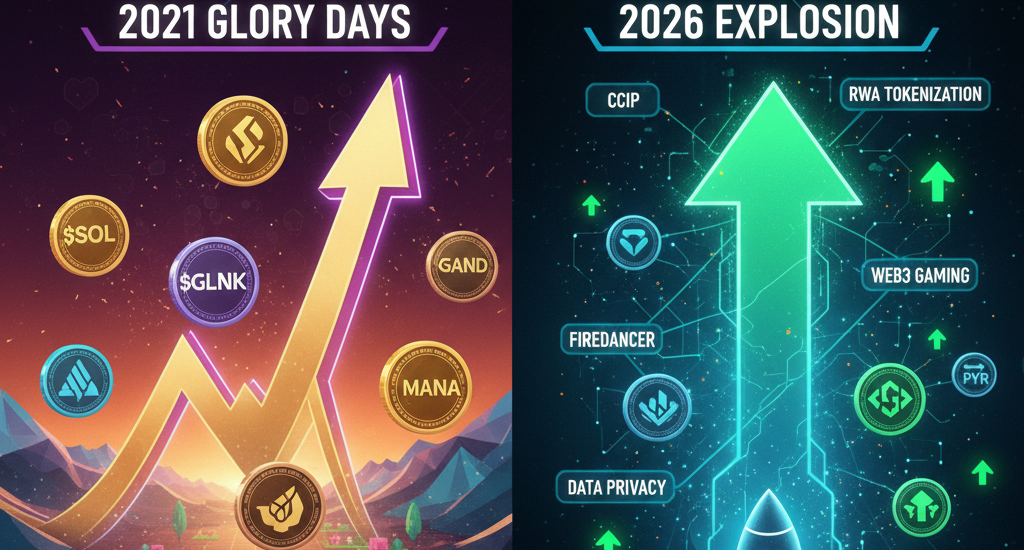
The roaring bull market of 2021 feels like a lifetime ago for many crypto investors. Remember when gaming tokens were soaring, DeFi protocols were breaking records daily, and the metaverse was the buzzword? Coins like Solana, Chainlink, GALA, and The Sandbox saw their prices hit dizzying All-Time Highs (ATHs), turning early investors into millionaires overnight.
Thank you for reading this post, don't forget to subscribe!
Fast forward to late 2025, and the landscape looks vastly different. Many of these former giants are languishing far below their peaks, battered by the bear market, rising interest rates, and a general cooling of speculative fervor. But for the discerning investor, this lull isn’t a sign of defeat – it’s an opportunity.
As we stand on the cusp of 2026, the question isn’t if these altcoins will rally again, but when and why. Are these the forgotten gems poised for a spectacular comeback? Let’s dive into the precise details of each coin and uncover their potential catalysts.
1. Solana (SOL): The “Ethereum Killer” Rebuilding Stronger
The 2021 Glory Days: Solana burst onto the scene as the undisputed “Ethereum Killer,” renowned for its lightning-fast transaction speeds (up to 65,000 TPS) and ultra-low fees. It became the go-to blockchain for DeFi, NFTs, and innovative dApps, peaking at an ATH of $260.00 in November 2021.
Why the Downtrend? SOL’s Achilles’ heel has been network stability. Frequent outages and congestion issues, particularly during periods of high demand, eroded developer and user trust. The association with the FTX collapse also hit confidence hard, as Alameda Research held significant SOL reserves.
When Will It Explode Again?
- Firedancer Upgrade: This highly anticipated upgrade aims to dramatically increase Solana’s throughput and reliability, potentially handling millions of transactions per second. If successful, it would virtually eliminate congestion.
- DeFi & NFT Resurgence: A general market upturn combined with a more stable network would bring back developers and users to Solana’s vibrant ecosystem.
- Institutional Adoption: Growing interest in high-performance blockchains for institutional-grade applications.
2. Chainlink (LINK): The Oracle Powerhouse Fueling the Future
The 2021 Glory Days: Chainlink solidified its position as the industry-standard decentralized oracle network, providing crucial real-world data to smart contracts. Its secure and reliable data feeds were indispensable for DeFi, driving its ATH to $52.70 in May 2021.
Why the Downtrend? While essential, oracles aren’t always “sexy” during a bear market. LINK’s price suffered from broader market corrections and a period where its utility was taken for granted amidst more speculative trends.
When Will It Explode Again?
- CCIP (Cross-Chain Interoperability Protocol): This is LINK’s game-changer. CCIP enables secure and seamless communication and value transfer between any blockchain, positioning Chainlink as the internet of blockchains.
- Real-World Asset (RWA) Tokenization: Chainlink is perfectly placed to provide secure data feeds for tokenized traditional assets (like real estate, bonds, and equities) coming onto the blockchain, a multi-trillion-dollar market.
- Staking V2: Enhanced staking mechanisms providing more utility and security for LINK holders.
3. Polkadot (DOT): The “Blockchain of Blockchains” with Interoperability
The 2021 Glory Days: Polkadot captivated the crypto world with its vision of a sharded, interoperable blockchain ecosystem. Its innovative parachain auctions allowed new blockchains to connect and secure their networks via the main Polkadot Relay Chain, pushing DOT to an ATH of $54.98 in November 2021.
Why the Downtrend? The complexity of its parachain model, while powerful, proved to be a barrier for some developers and investors. The lengthy auction process and the initial learning curve meant adoption was slower than some competitors.
When Will It Explode Again?
- Coretime & Async Backing: Upcoming upgrades will simplify parachain acquisition and significantly increase block space, making it easier and cheaper for projects to build on Polkadot.
- XCM (Cross-Consensus Message Format) Adoption: As more projects leverage XCM for seamless cross-chain communication, Polkadot’s “blockchain of blockchains” vision will fully materialize.
- Decentralized ID (DID) & Web3 Identity: Polkadot’s robust security and interoperability make it ideal for the emerging Web3 identity layer, attracting high-value applications.
4. The Sandbox (SAND) & Decentraland (MANA): Metaverse Pioneers on Pause
The 2021 Glory Days: These two were the poster children of the metaverse boom, riding high on the “Facebook rebrand to Meta” narrative. Virtual land prices skyrocketed, and major brands flocked to build experiences. SAND hit an ATH of $8.44 and MANA reached $5.90 in November 2021.
Why the Downtrend? The metaverse hype outpaced technological reality. High development costs, clunky user experiences, and a lack of mass adoption beyond speculation led to a significant cooldown. Many early “play-to-earn” games proved unsustainable.
When Will They Explode Again?
- Improved User Experience & Graphics: The next wave of metaverse adoption requires smoother, more engaging experiences that genuinely compete with traditional gaming.
- Strategic Partnerships & IP: Continued integration with major global brands and entertainment IPs could reignite interest.
- Interoperability: The ability for avatars and assets to move seamlessly between different metaverse platforms.
- Gaming Evolution: A shift from purely “earning” to truly fun and immersive gameplay that happens to incorporate Web3 elements.
5. Gala (GALA): From Play-to-Earn to “Fun-to-Own” Gaming
The 2021 Glory Days: Gala Games was at the forefront of the P2E revolution, promising players ownership of in-game assets and the ability to earn GALA tokens. Its suite of games and ambitious vision propelled GALA to an ATH of $0.83in November 2021.
Why the Downtrend? The P2E model faced significant challenges, including tokenomics that led to sell pressure, and games that prioritized “earning” over “entertainment.” Many players found the gameplay lacking once the earning potential diminished.
When Will It Explode Again?
- Focus on Quality Gameplay: Gala’s pivot to “fun-first” gaming, emphasizing high-production value and engaging experiences rather than just token rewards.
- GalaChain: Their proprietary blockchain aims to reduce transaction fees and improve scalability, enhancing the gaming experience.
- New Game Releases: Successful launches of highly anticipated titles that attract a broad gaming audience.
- Entertainment Expansion: Gala’s move into film, music, and other entertainment verticals could create a broader ecosystem.
6. Jasmy (JASMY): Japan’s “Bitcoin” for Data Privacy
The 2021 Glory Days: Often dubbed “Japan’s Bitcoin,” Jasmy captivated investors with its focus on data security and the Internet of Things (IoT). Its promise to return data ownership to individuals resonated deeply, driving its ATH to $4.99 in February 2021 (though its more widely recognized bull run peak was lower due to supply dynamics).
Why the Downtrend? JASMY’s price action has been notoriously volatile, often suffering from macro crypto trends and the long development cycles inherent in building enterprise-grade IoT solutions. Its tokenomics, with a large circulating supply, also presented challenges.
When Will It Explode Again?
- IoT & Web3 Integration: As more devices become connected and Web3 gains traction, the need for secure, decentralized data management will become critical.
- Regulatory Clarity in Japan: Favorable regulatory environments in Japan for crypto and data privacy initiatives could significantly boost adoption.
- Partnerships & Enterprise Adoption: Strategic collaborations with major tech companies and successful deployment of its data locker technology.
7. Vulcan Forged (PYR): The Metaverse with Substance
The 2021 Glory Days: Vulcan Forged (PYR) carved out a niche as a robust blockchain gaming studio and NFT marketplace with its own metaverse, VulcanVerse. Its ecosystem-first approach saw PYR reach an ATH of $49.27 in December 2021.
Why the Downtrend? Like other metaverse and gaming projects, PYR suffered from the broader bear market and the cooling of P2E hype. Competition in the blockchain gaming space is fierce, and sustained growth requires continuous innovation.
When Will It Explode Again?
- Vulcan-X Engine & Elysium Blockchain: Their focus on empowering developers to build high-quality games on their layer-1 blockchain (Elysium) could attract a new wave of gaming projects.
- New Game Launches & Ecosystem Growth: The release of more AAA-quality games and the expansion of VulcanVerse will be crucial for user acquisition.
- NFT Marketplace Dominance: Continued growth and unique offerings on their NFT marketplace.
The Road Ahead: Cautious Optimism for 2026
The journey for these altcoin “legacy” projects has been arduous since their 2021 peaks. Yet, what doesn’t kill them makes them stronger. The current market phase has forced many projects to shed unsustainable models, focus on core technology, and build for genuine utility rather than pure speculation.
As we head into 2026, a more mature and resilient crypto market, potentially fueled by Bitcoin’s stability and institutional adoption, could provide the perfect environment for these innovative altcoins to not just recover, but potentially set new ATHs. The key lies in their ability to deliver on their promises of scalability, interoperability, and genuine user value.
Keep a close eye on these projects. Their quiet building during the bear market could soon translate into an explosive performance as the next bull cycle unfolds.