Decode crypto’s inner workings. Learn about mining, airdrops, Proof of Stake, and other key mechanisms that power blockchain and secure your digital assets
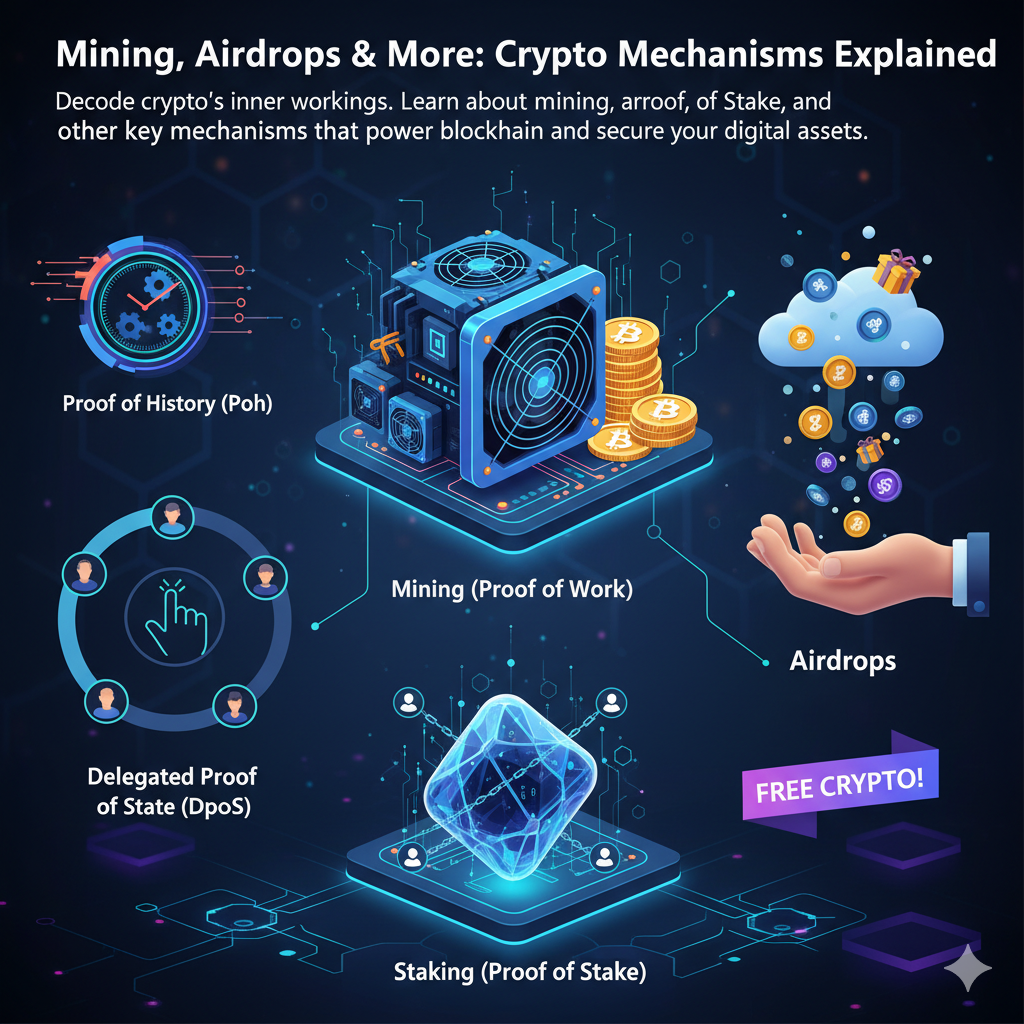
The world of cryptocurrency is built on fascinating and often complex technical concepts. While you might hear terms like “mining” or “staking,” what do they actually mean? They are the different engines that power blockchain networks, each with its own way of validating transactions and securing the system.
Here’s a clear breakdown of the most important mechanisms you need to know.
1. Mining (Proof of Work)
Think of mining as a digital lottery where miners compete to solve a complex mathematical puzzle. The first miner to solve the puzzle wins the right to add the next block of transactions to the blockchain.
- How It Works: Miners use powerful computers to perform intense calculations to find a specific code, or “hash.”This process is known as Proof of Work (PoW). The difficulty of the puzzle is self-adjusting to ensure that a new block is found, on average, every ten minutes (for Bitcoin).
- What It Does: This process serves two main purposes:
- Validates Transactions: It ensures that all transactions are legitimate and accurate.
- Secures the Network: The sheer amount of computing power required makes it nearly impossible for a single entity to take over the network, protecting it from attacks.
- Key Example: Bitcoin is the most famous cryptocurrency that uses Proof of Work.
2. Staking (Proof of Stake)
Staking is a newer, more energy-efficient alternative to mining. Instead of competing to solve puzzles, validators are chosen to create new blocks based on how much cryptocurrency they “stake,” or lock up, as collateral.
- How It Works: In a Proof of Stake (PoS) system, a validator is randomly selected to propose and validate a new block. The chance of being selected is proportional to the amount of crypto they have staked. If the validator acts dishonestly, they can lose their staked funds, a process known as “slashing.”
- What It Does:
- Secures the Network: It uses economic incentives (rewards for honest behavior, penalties for dishonest behavior) rather than computational power.
- Saves Energy: It consumes significantly less electricity, making it a much more sustainable option.
- Key Example: Ethereum, the second-largest cryptocurrency, moved from a PoW to a PoS model in 2022, a major event known as “The Merge.”
3. Airdrops
An airdrop is a method of distributing free cryptocurrency to a large number of wallet addresses. It’s essentially a marketing and community-building tool used by projects.
- How It Works: A project sets a specific date and time, takes a “snapshot” of the blockchain, and automatically sends free tokens to wallet addresses that meet certain criteria.
- Why Projects Do It:
- Marketing & Buzz: It’s a powerful way to generate hype and get a new token in the hands of potential users.
- Community Building: It rewards early supporters and users who may have contributed to the ecosystem.
- Fair Distribution: It can help decentralize a token by spreading it out among many different people, rather than just a few early investors.
Other Important Mechanisms
The world of crypto consensus is constantly evolving, with new and innovative approaches emerging.
- Delegated Proof of Stake (DPoS): A more democratic version of PoS. Token holders vote for a smaller group of “delegates” to validate transactions on their behalf. This can lead to faster transaction speeds. Example: EOS and TRON.
- Proof of Authority (PoA): This mechanism relies on a small, pre-approved list of validators who are known and trusted entities. It’s often used in private or consortium blockchains where speed and efficiency are prioritized over complete decentralization. Example: VeChain.
- Proof of History (PoH): A unique mechanism used by Solana that acts as a verifiable clock for the blockchain. It doesn’t create consensus on its own but works alongside PoS to provide a historical record of events, allowing for extremely fast transaction processing.
Understanding these different mechanisms is key to understanding the crypto world. Each one represents a unique trade-off between security, speed, energy consumption, and decentralization, driving the innovation that makes the crypto ecosystem so exciting.
Disclaimer: This article is for informational purposes only and is not financial advice. Cryptocurrency investments are highly volatile and speculative. We recommend you conduct your own research and consult a financial professional before making any investment decisions.