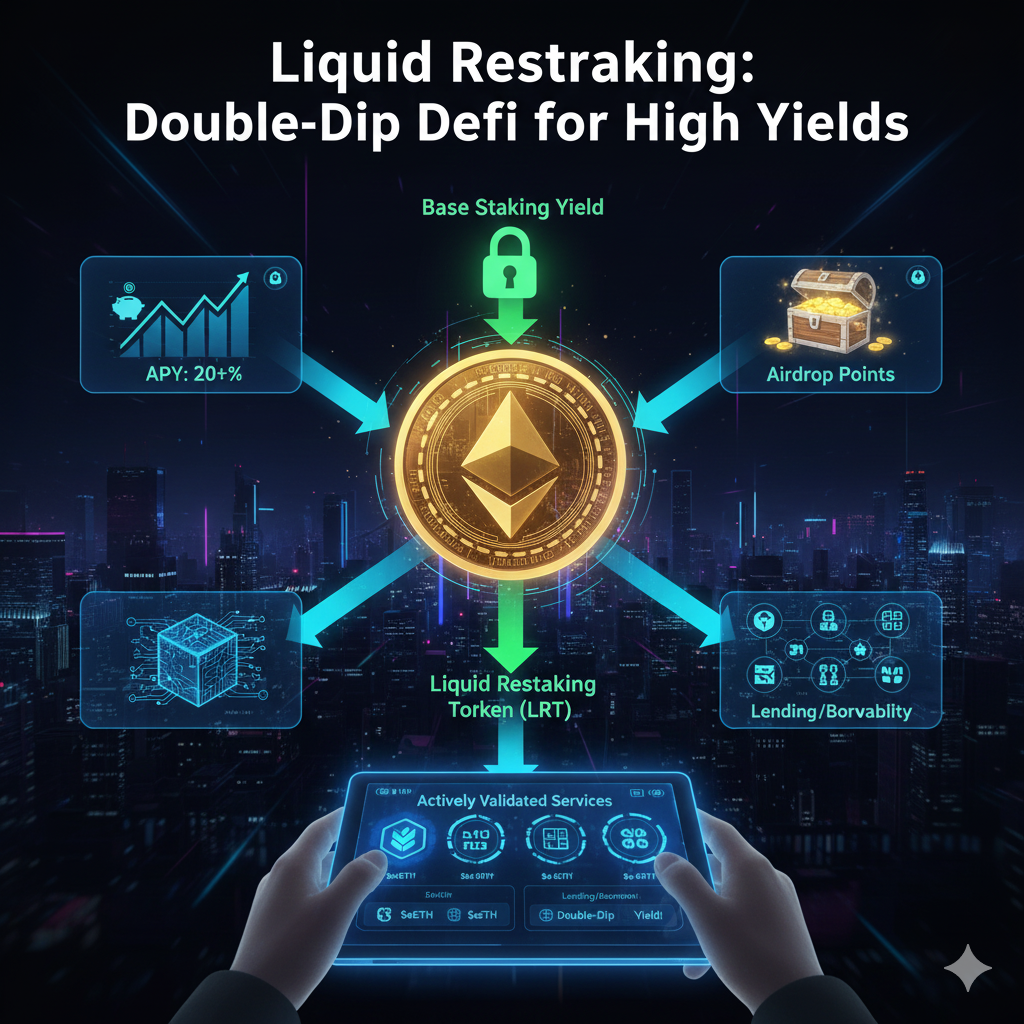
In the world of crypto, capital efficiency is king. For years, staking meant locking up assets for a single reward. Then came Liquid Staking Tokens (LSTs like $stETH), allowing staked assets to be used in DeFi.
But 2025 has introduced the next evolution: Liquid Restaking.
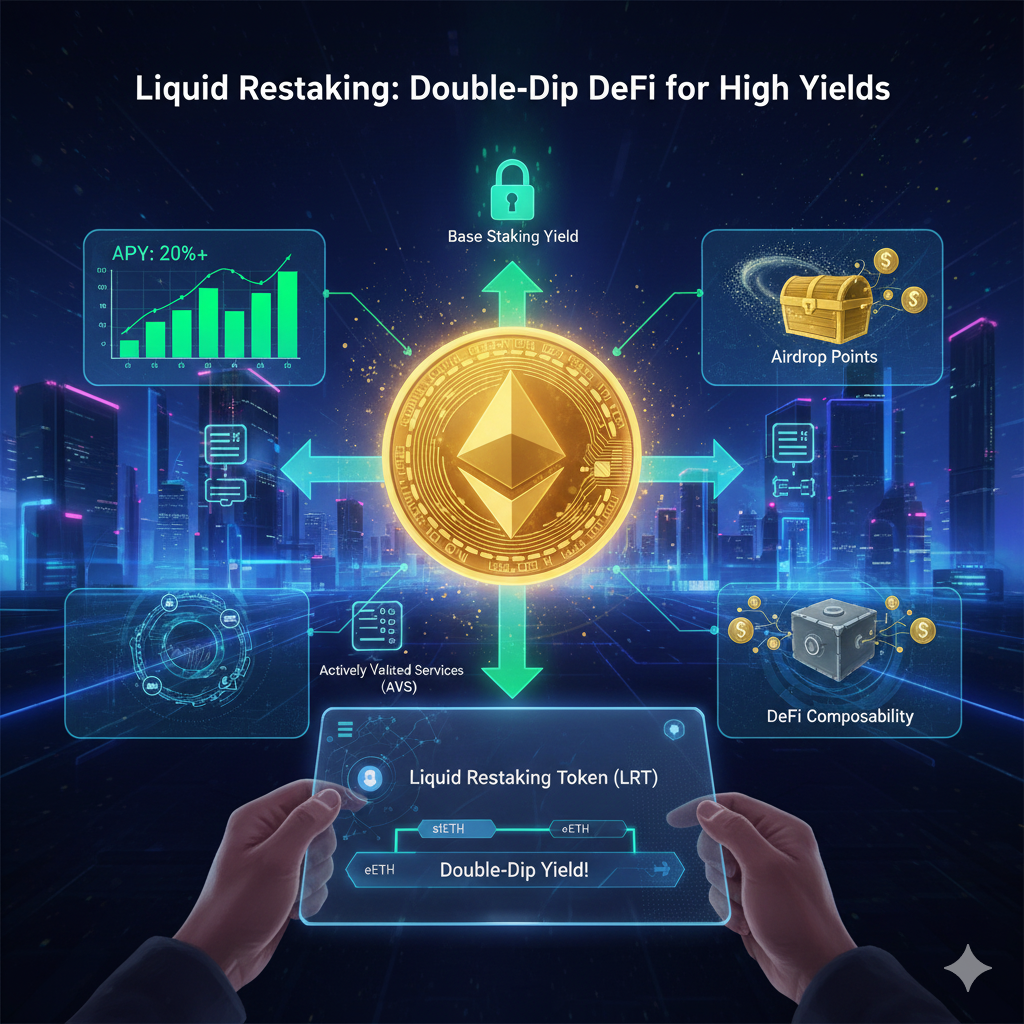
Liquid Restaking is the process of taking your already staked asset (an LST) and re-staking it on a secondary protocol, essentially using the same capital to secure multiple networks simultaneously. This “double-dipping” mechanism is responsible for some of the highest and most complex yields in DeFi today, making it a red-hot topic on YouTube channels worldwide.
1. The Mechanics: How You Double-Dip with LRTs
Liquid Restaking Tokens (LRTs) were primarily popularized by platforms like EigenLayer on Ethereum, though the concept is now expanding across multiple chains.
The Three-Layer Process:
- Layer 1: Traditional Staking: You lock up your base asset (e.g., $ETH) with a liquid staking provider (e.g., Lido, Rocket Pool) and receive a Liquid Staking Token (LST) in return (e.g., $stETH, $rETH). This earns you the base Ethereum staking reward (e.g., 3-5% APY).
- Layer 2: The Restake: You take that LST ($stETH) and deposit it into a Restaking Protocol (e.g., EigenLayer). Your $stETH is now used to secure a new set of services called Actively Validated Services (AVSs).
- Layer 3: The Liquid Restaking Token (LRT): To maintain liquidity and track your multi-layered position, you receive an LRT (e.g., $eETH from Ether.fi, $rsETH from Renzo). This LRT represents your full restaked position, allowing you to use it across DeFi.
💡 Core Concept: You are earning the base staking yield (Layer 1) PLUS the AVS service fee rewards(Layer 2) on the same initial capital, maximizing your asset’s efficiency.
2. The Yield Opportunities: Where the Returns Come From
The potential for higher returns makes LRTs incredibly attractive, often pushing the blended APY well into double digits.
| Yield Source | Description | APY Contribution |
| Base Staking Yield | Rewards from securing the main Proof-of-Stake chain (e.g., Ethereum). | ~3-5% |
| AVS Service Fees | Compensation for extending security to new protocols (Oracles, Data Availability Layers like EigenDA, bridges). | Highly Variable, often 5-15%+ |
| DeFi Composability | Using your LRT as collateral for loans, or pooling it on a DEX for trading fees. | Highly Variable, often 2-8% |
| Protocol Points/Airdrops | Protocols often reward early restakers with “points” that lead to future token airdrops (e.g., EigenLayer Points, Renzo Points). | Highly Speculative, but often the biggest driver of initialinterest. |
This layered system of rewards allows a sophisticated DeFi user to generate significantly higher capital efficiency than with traditional staking alone.
3. Key Protocols Leading the LRT Race (2025)
The LRT ecosystem is one of the fastest-growing sectors in crypto history, with TVL (Total Value Locked) on Ethereum alone surging past $30 billion in late 2025.
- Ether.fi ($ETHFI): The largest LRT protocol by TVL, known for its native LRT ($eETH). It’s pioneering institutional integration, even rolling out Visa payment cards in the U.S.
- EigenLayer ($EIGEN): The core protocol that invented the restaking mechanism. While it doesn’t issue a liquid token, it provides the essential marketplace for validators and AVSs.
- Renzo Protocol ($REZ): A quickly growing player that provides multi-chain restaking options (including $ETH and $SOL), positioning itself as a universal restaking solution.
4. Navigating the Risks: The Dangers of Layered Yield
Higher yield always comes with higher risk. Understanding these risks is crucial:
- Slashing Risk: As an LRT user, you agree to secure AVSs. If the validator you are delegated to misbehaves on anyof those protocols, your underlying staked $ETH can be slashed (partially destroyed). You are exposed to security risks across multiple layers, not just one.
- Smart Contract Risk: You are interacting with three layers of smart contracts (LST Protocol → Restaking Protocol → LRT Protocol). Each layer is a potential point of failure or hack.
- De-peg Risk: An LRT is a derivative asset. If an LRT protocol experiences technical issues or high redemption pressure, its price may temporarily fall below the value of the underlying $ETH (a de-peg), as happened with one protocol in early 2024.