

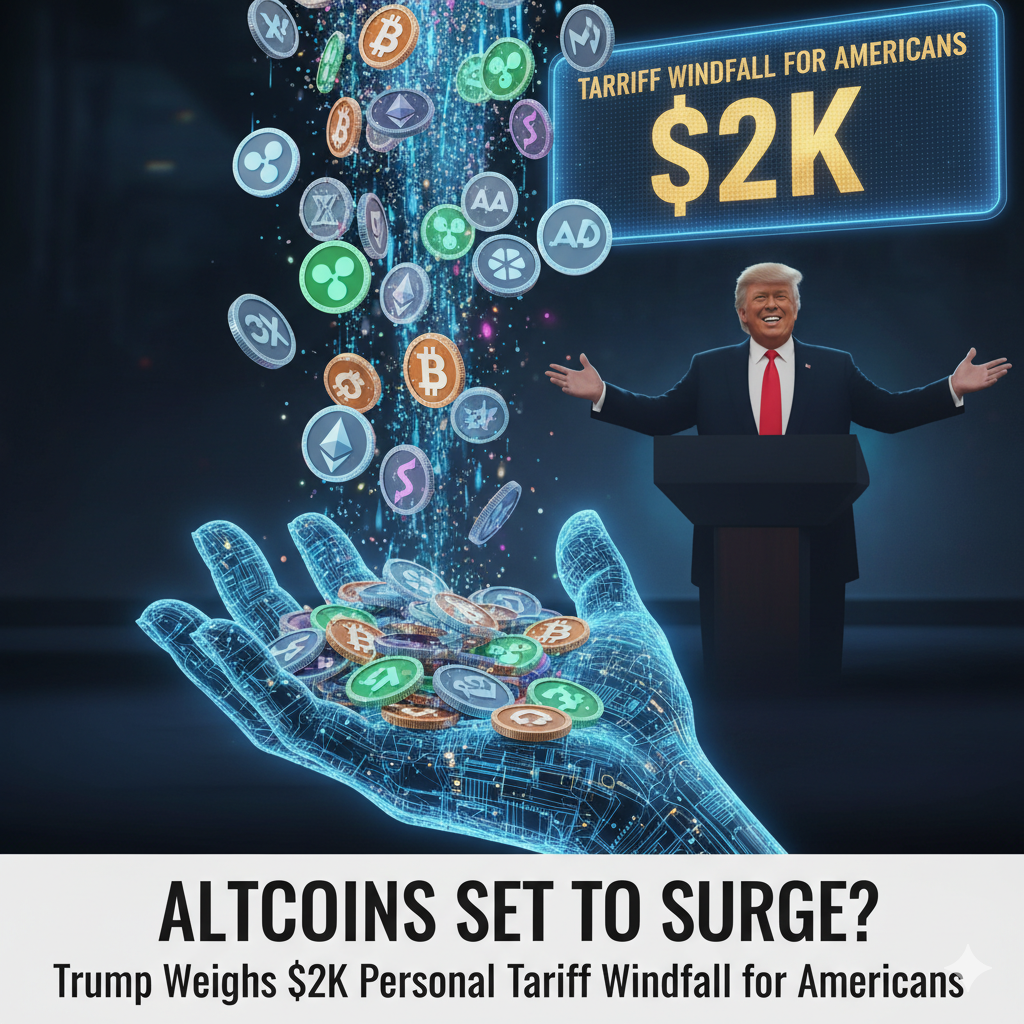
Trump’s proposed $2K tariff rebate could boost crypto markets. Analysts say altcoins may benefit, but higher rates may limit broad speculative rallies.

Introduction
The cryptocurrency market is once again in the spotlight following reports that former President Donald Trump is considering a $2,000 per-person rebate, funded through tariff revenues. Supporters are calling it a “tariff dividend”, a potential way to return government revenues directly to U.S. households.
Thank you for reading this post, don't forget to subscribe!
For crypto investors, this raises an important question: could such payments fuel a new wave of capital into altcoins, the cryptocurrencies beyond Bitcoin and Ethereum? Past stimulus programs during the pandemic years offer strong clues—and the possibility of another altcoin season has traders watching closely.
What Is the Proposed Tariff Dividend?
Trump has long advocated tariffs as a way to bolster U.S. economic independence. In his latest comments, he suggested that tariffs could eventually raise over $1 trillion per year. While he stressed that much of this money would be used to reduce the national debt, he also floated the idea of direct cash payments to Americans, potentially up to $2,000 per person.
This concept differs from typical tax rebates or government assistance programs. Instead, the rebates would be explicitly tied to tariff revenues—effectively redistributing money collected from foreign imports back to U.S. households.
For everyday Americans, that would mean an extra financial cushion. For investors, it may unlock fresh capital for savings, debt repayment, or riskier plays such as crypto.
Why Cash Rebates Often Boost Crypto Markets
Economic history shows that when people receive direct government payments, many use a portion for investment and speculation. During the pandemic, U.S. households received multiple rounds of stimulus checks, and part of that money flowed directly into digital assets.
- In 2020–2021, Bitcoin surged to new highs while dozens of altcoins experienced explosive growth.
- Academic evidence supports the link: A 2023 study by Marco Di Maggio and colleagues found that easing household financial constraints through direct payments tends to increase crypto participation.
For many younger investors, crypto represents both a speculative opportunity and, in some cases, a hedge against inflation. Additional disposable income, like a $2,000 rebate, can lower the psychological barrier to putting money into volatile assets.
Lessons from the Pandemic Altcoin Boom
During the last major altcoin season, the effect of stimulus checks was unmistakable. Bitcoin’s dominance—a measure of its share of the overall crypto market—fell sharply as retail investors poured money into smaller tokens.
- In early 2020, Bitcoin controlled about 73% of the crypto market.
- By mid-2021, its share had dropped to under 40%, as altcoins like Solana (SOL), Cardano (ADA), and meme coins captured investor enthusiasm.
Analysts noted that retail-led inflows, combined with the lack of strong institutional infrastructure at the time, created fertile conditions for speculative runs in smaller cryptocurrencies. The result was one of the most dramatic altcoin rallies in history.
Why 2025 May Be Different
While the idea of another altcoin boom is appealing, today’s market conditions look very different from those in 2020–21.
1. Higher Interest Rates
Back then, U.S. interest rates were near 0%, making traditional savings unattractive and pushing investors into risk assets. Today, rates hover above 4%, meaning cash and bonds now offer meaningful returns. This reduces the urgency to chase risky gains.
2. Larger Market Cap
The crypto market is much larger now than it was during the pandemic. With a higher total capitalization, it takes more capital inflows to generate the same percentage gains. In short: it’s harder to move the needle.
3. Focus on Utility Over Hype
Investors are becoming more discerning. Rather than chasing speculative tokens with no clear use case, many are prioritizing projects with utility—such as decentralized finance (DeFi), blockchain infrastructure, and real-world asset (RWA) tokenization.
This suggests that if another altseason comes, it will be selective, favoring projects with fundamentals over hype-driven surges.
Market Snapshot: Altcoins Lagging in 2025
Year-to-date, the CoinDesk 20 Index, which tracks the largest cryptocurrencies, has risen nearly 50%. By contrast, the CoinDesk 80 Index, which includes smaller altcoins, has seen more modest growth.
This performance gap shows that while capital is flowing into crypto, it remains concentrated in well-established tokens like:
- Bitcoin (BTC)
- Ethereum (ETH)
- Solana (SOL)
- BNB (BNB)
- XRP (XRP)
Smaller, speculative altcoins have yet to see the same level of momentum.
How Tariff Rebates Differ from Stimulus Checks
It’s important to note that a tariff dividend is not the same as pandemic-era stimulus checks.
- Stimulus payments were funded directly by government borrowing, injecting new money into the economy.
- Tariff rebates, on the other hand, would recycle money collected from imports. The amount distributed would depend on how much tariff revenue is actually generated.
This raises uncertainties: would the program be consistent and predictable enough to influence investor behavior in the same way stimulus checks did? Or would households treat it more cautiously?
Potential Risks for Altcoin Investors
Even if rebates lead to fresh inflows, investors should remain aware of the risks:
- Regulatory pressure – U.S. regulators continue to scrutinize smaller altcoins, especially those that may qualify as securities.
- Volatility – Altcoins remain far more volatile than Bitcoin and Ethereum, making them riskier bets.
- Macroeconomic shocks – A global slowdown or financial instability could overshadow any positive effect from rebates.
- Timing uncertainty – Trump’s plan is still just a proposal. Implementation, if it happens, could take time and face political resistance.
What to Watch if Rebates Are Approved
If the tariff dividend becomes reality, investors should track:
- Household savings rates: Are people saving, spending, or investing their rebates?
- Altcoin trading volumes: A rise in trading activity on major exchanges could indicate a new retail-driven cycle.
- Bitcoin dominance: If BTC’s share of the market starts to fall, it may signal the beginning of an altcoin season.
- Selective growth: Look for gains in projects tied to DeFi, AI integration, or tokenized assets, rather than across-the-board rallies.
Could This Trigger a Selective Altcoin Season?
Unlike the wild, broad-based rally of 2021, any altcoin season sparked by tariff rebates would likely be narrower and more strategic. Investors and institutions alike are now more focused on sustainability, compliance, and utility.
That doesn’t mean there won’t be opportunities. On the contrary, selective capital allocation could reward projects that demonstrate real value, while speculative meme tokens may struggle to keep up.
Conclusion
Trump’s proposed $2,000 tariff rebate has sparked excitement across financial markets, with crypto traders speculating about a potential altcoin rally. Past evidence shows that government payments can indeed fuel inflows into digital assets, but today’s environment is markedly different: interest rates are higher, the market is larger, and investors are more discerning.
If the plan materializes, it may drive capital into crypto—but rather than another indiscriminate altcoin frenzy, we could see a selective rally led by projects with genuine utility. For investors, that means opportunities exist, but careful research and risk management will be more important than ever.
Disclaimer: This article is for informational purposes only and does not constitute financial or investment advice. Always do your own research before investing.