
Dive into the world of CEX. Learn how centralized crypto exchanges facilitate trading, their security features, user-friendliness (Coin-base vs. Binance), and what makes them reliable.
Thank you for reading this post, don't forget to subscribe!

💰 Crypto Exchanges 101: Your Complete Guide to Centralized Trading Platforms
Welcome to the definitive guide on Centralized Crypto Exchanges (CEX)! If you’ve ever bought Bitcoin or Ether using a platform that feels like a standard online brokerage, you’ve used a CEX. These platforms are the primary on-ramp for most people entering the crypto space, acting as a vital link between the traditional financial world (fiat currency) and the new digital asset economy.
🛠️ How Centralized Crypto Exchanges Work
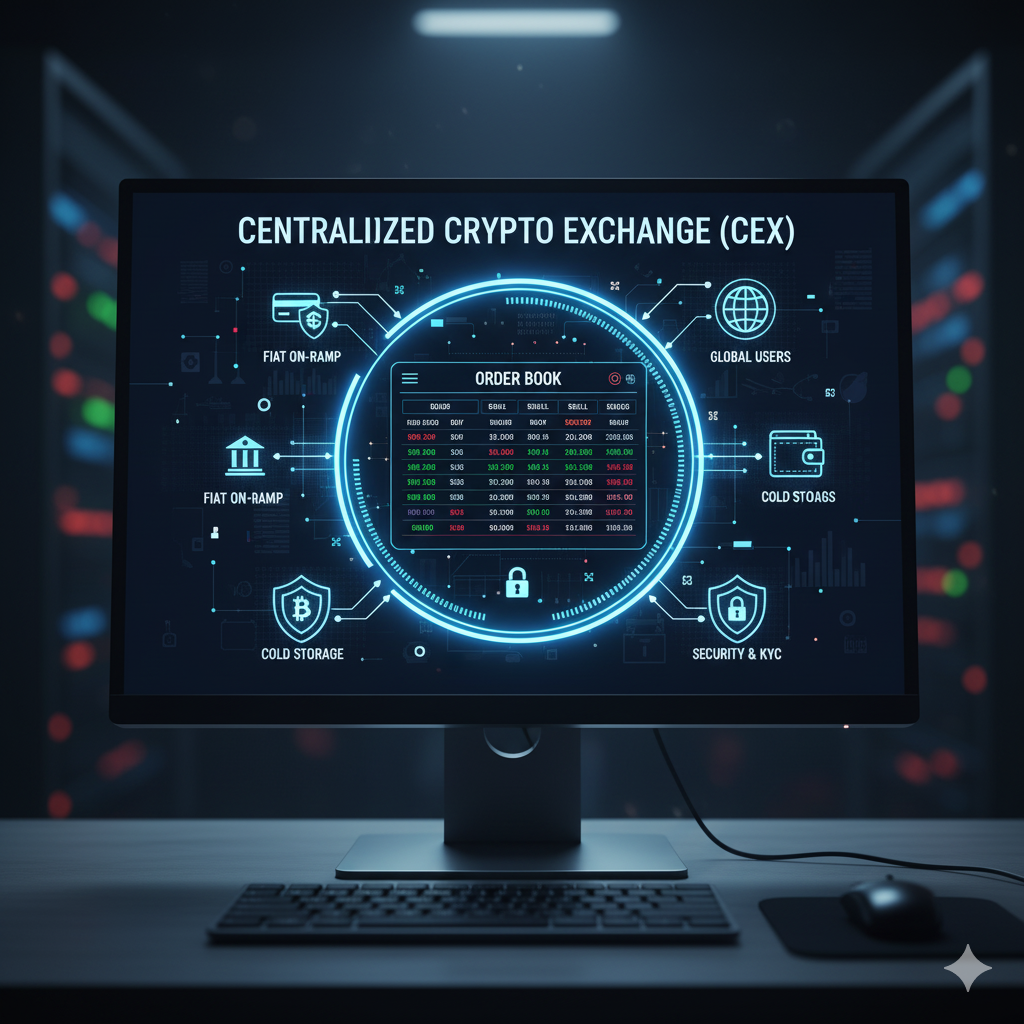
Think of a CEX as a digital brokerage and bank hybrid for cryptocurrencies. They are owned and operated by a single company (hence, “centralized”) and function by acting as a trusted intermediary between buyers and sellers.
The Intermediary Model
- Custodian of Funds: When you deposit money or crypto, the exchange takes custody of the assets on your behalf. They manage the private keys to the wallets where your crypto is stored. This is often summarized by the phrase, “Not your keys, not your crypto,” as you trust the exchange with your assets.
- Order Book System: The core of a CEX is its trading engine, which uses an order book. This is a real-time list of all the buy and sell orders for a specific crypto pair (e.g., BTC/USD).
- A Limit Order lets you set a specific price to buy or sell.
- A Market Order is executed immediately at the best available price.
- Matching Engine: The exchange’s system automatically matches buyers and sellers based on the best executable price, ensuring trades are executed quickly and efficiently.
- Fiat Conversion: CEXs are critical for fiat-to-crypto and crypto-to-fiat conversions (known as on-ramping and off-ramping). This is a feature often unavailable on Decentralized Exchanges (DEXs).
🔒 Are CEXs Safe and Secure?
Security is paramount when dealing with digital assets. While major CEXs have invested billions in protecting user funds, no platform is entirely immune to risk.
Key Security Measures Implemented by Top Exchanges
| Security Feature | Description |
| Cold Storage | Storing the vast majority of customer cryptocurrency offline, in wallets that are not connected to the internet. This protects funds from online hacking attempts. |
| Two-Factor Authentication (2FA) | A critical user-side protection. Requires a code from a separate device (like Google Authenticator or a security key) in addition to a password to log in or withdraw funds. |
| Insurance Funds | Some major exchanges (like Binance and Kraken) maintain large insurance funds (e.g., SAFU for Binance) to protect a portion of customer assets in the event of a platform hack. |
| Regulatory Compliance | Many large CEXs, particularly those based in regulated jurisdictions (like Coinbase and Kraken in the US), adhere to strict Know Your Customer (KYC) and Anti-Money Laundering (AML) laws. This adds a layer of governmental oversight and accountability. |
| Proof of Reserves (PoR) | A transparency measure where exchanges hire third-party auditors to verify that the crypto they hold on behalf of customers matches the total liabilities. Kraken is notable for pioneering this practice. |
The Custody Risk
The biggest risk remains the centralized nature of the platform. If the exchange is hacked, becomes insolvent, or engages in fraudulent activity (as seen with FTX), your funds are at risk because the exchange holds the keys. However, the top-tier, most regulated exchanges have maintained strong security track records.
🤝 User-Friendly and Reliable?
For the average user, CEXs are designed for maximum accessibility and reliability compared to their decentralized counterparts.
User-Friendliness
- Beginner-Friendly Interfaces: Exchanges like Coinbase are famous for their incredibly intuitive and clean interfaces, making the process of buying and selling crypto simple for first-time users. They act as an “easy button” for crypto investment.
- Advanced Tools: Platforms like Kraken Pro and Binance offer separate, more advanced trading platforms with complex charting tools, margin trading, and derivatives for experienced users.
- Customer Support: Unlike DEXs, which often have no formal customer support, CEXs provide 24/7 customer service via email, live chat, or even phone in some cases, greatly enhancing the user experience, especially when dealing with technical issues.
Reliability
- High Liquidity: Due to their massive user bases and trading volumes, CEXs have deep liquidity. This means you can buy or sell large amounts of crypto quickly without significantly affecting the price, making them highly reliable for trade execution.
- Speed and Efficiency: Trades are executed off-chain on the exchange’s private servers, resulting in near-instantaneous transactions, unlike on-chain transactions on DEXs which must wait for blockchain confirmation.
- Track Record: Established exchanges like Kraken (founded 2011) and Coinbase (founded 2012) have stood the test of time, enduring multiple crypto market cycles and maintaining a strong reputation for security and regulatory compliance.
| Exchange Comparison Snapshot | Best For | User-Friendliness | Security Reputation |
| Coinbase | Beginners & Long-Term Investors | Excellent (Very Simple UI) | Highly Regulated, Strong Security Track Record |
| Kraken | Security-Focused & Advanced Traders | Good Balance (Pro version for experts) | Industry-Leading, Never Hacked (Custodial Wallets) |
| Binance | Broad Altcoin Selection & Lowest Fees | Moderate (Can be overwhelming, but offers ‘Lite’ mode) | Very High Volume, Large Security Fund (SAFU) |
💡 Conclusion: Choosing the Right Exchange
Centralized Crypto Exchanges offer a crucial balance of user-friendliness, reliability, and institutional-grade security, making them the go-to option for most crypto users. While the inherent risk of centralizing asset custody exists, the top platforms mitigate this through robust security protocols and increasing regulatory oversight.
Your choice of exchange will likely depend on your priorities: Coinbase for simplicity, Kraken for maximum security focus, or Binance for the most extensive coin selection and low fees. Always remember the fundamental rule of crypto: to fully secure your assets, move them off the exchange and into a hardware wallet once your trading is complete.