
If you are following the evolution of blockchain, you have likely heard a specific phrase repeated by major banks, asset managers, and developers: “The Oracle Problem.”
Thank you for reading this post, don't forget to subscribe!

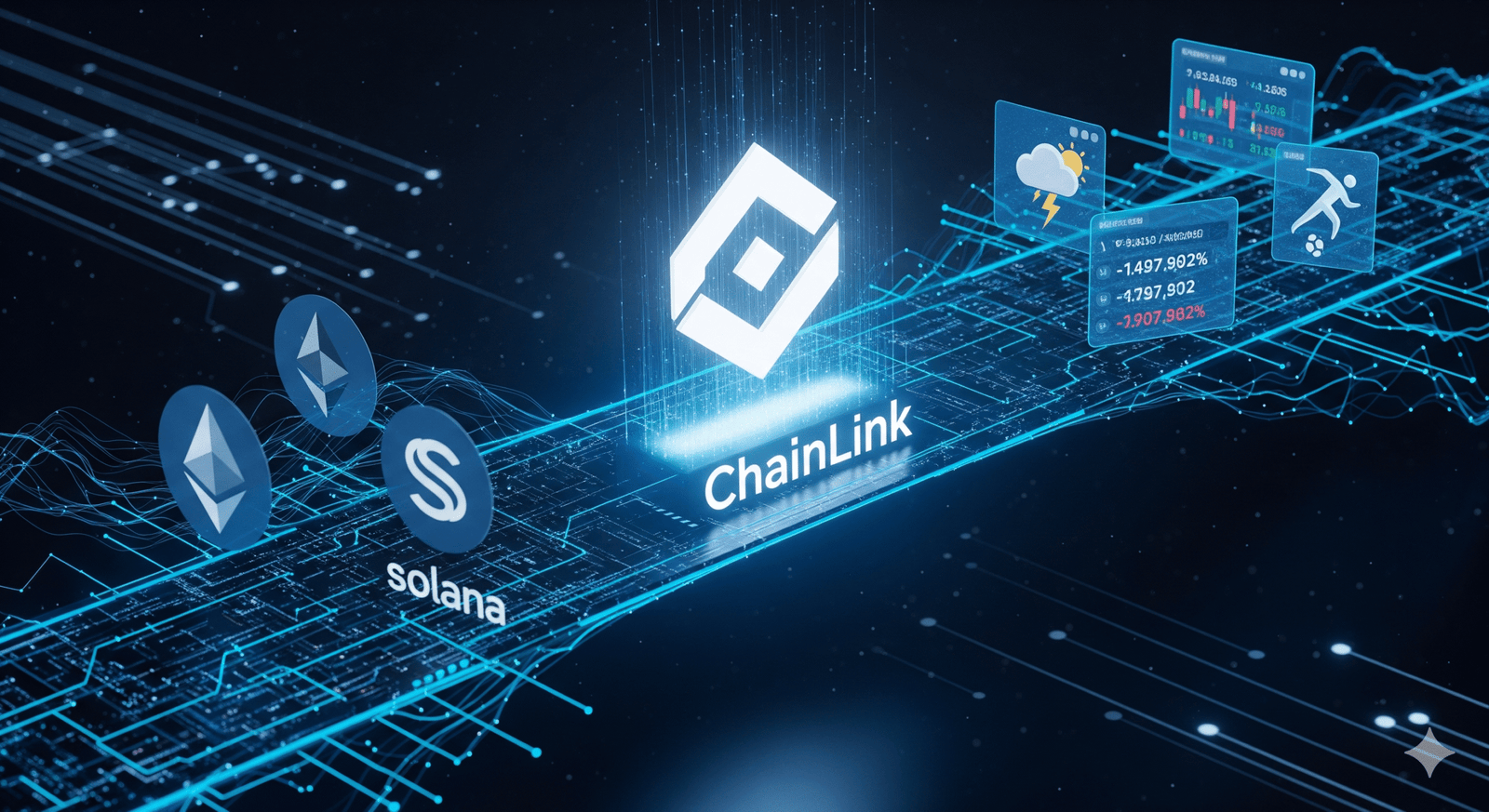
Blockchains like Ethereum and Solana are incredibly secure, but they have a major flaw: they are isolated. They can’t “see” the outside world. A smart contract on the blockchain doesn’t know the price of Tesla stock, the winner of the Super Bowl, or if a shipping container has arrived in port.
This is where Chainlink (LINK) comes in. It is not just another cryptocurrency; it is the industry-standard bridge connecting the digital blockchain world with the real world.
Here is everything you need to know about Chainlink, its upgraded economic model, and why it is positioned to be the backbone of the future financial system.
1. What is Chainlink? (The Simple Explanation)
At its core, Chainlink is a Decentralized Oracle Network (DON).
In ancient mythology, an “oracle” was a source of truth. In crypto, an oracle is a piece of middleware that fetches data from the real world, verifies it, and delivers it to a blockchain smart contract.
- Without Chainlink: A smart contract is limited to tokens already on its own blockchain.
- With Chainlink: A smart contract can automate crop insurance payouts based on local weather data, settle a sports bet based on ESPN scores, or trade synthetic stocks based on the NYSE.
Chainlink solves the “single point of failure” problem by using a decentralized network of independent nodes to verify data. If one node lies or fails, the others outvote it, ensuring the data remains accurate and tamper-proof.
2. The Tech Stack: More Than Just Price Feeds
While Chainlink started by providing price data for DeFi (Decentralized Finance), it has evolved into a comprehensive computing platform.
CCIP: The “TCP/IP” of Blockchain
The Cross-Chain Interoperability Protocol (CCIP) is arguably Chainlink’s most important innovation. Just as TCP/IP allowed different computer networks to form the internet, CCIP allows different blockchains (like Ethereum, Avalanche, and Base) to talk to each other securely.
- Why it matters: It enables “programmable token transfers.” You could send collateral from one chain and borrow against it on another in a single transaction.
Chainlink Confidential Compute (DECO & Privacy)
Institutions like JPMorgan and Swift want to use blockchain, but they can’t expose sensitive customer data on a public ledger. Chainlink’s privacy technologies (like the DECO protocol) allow oracles to prove data is true without revealing the data itself.
- Use Case: Proving a user is over 18 without revealing their date of birth, or proving a bank has sufficient liquidity without revealing its total balance.
3. Chainlink Economics 2.0: A Sustainable Future
In the past, Chainlink was criticized for not having a clear value capture mechanism for the LINK token. That changed with Economics 2.0, a roadmap designed to make the network economically sustainable.
Staking
LINK holders can now stake their tokens to secure the network. If an oracle node acts maliciously or fails to deliver data, a portion of their staked LINK can be slashed (taken away). This creates a powerful financial incentive for honesty and reliability.
The BUILD Program
Think of this as an accelerator. Early-stage crypto projects give a portion of their native token supply to Chainlink stakers. In exchange, they get priority access to Chainlink services and technical support. This aligns the success of new projects with the value of the LINK token.
The SCALE Program
Blockchains (Layer 1s and Layer 2s) cover the operating costs of Chainlink oracles (known as “gas costs”) to boost their own ecosystems. This reduces the cost for developers building on those chains, encouraging more innovation while ensuring Chainlink oracles are paid.
4. Future Potential: The RWA Revolution
The biggest bullish case for Chainlink isn’t crypto—it’s Traditional Finance (TradFi).
We are witnessing the start of the Tokenization of Real-World Assets (RWAs). This is the process of putting stocks, bonds, real estate, and carbon credits on the blockchain.
- The Projection: Reports from institutions like Citi and Boston Consulting Group estimate the tokenized asset market could reach $10 trillion to $16 trillion by 2030.
Chainlink is the Key Infrastructure
Chainlink is positioning itself as the standard platform for this transition.
- Swift Partnership: Chainlink has successfully tested transactions with Swift, the messaging network used by over 11,000 banks worldwide. They proved that existing bank systems can transact with blockchains using CCIP.
- DTCC Collaboration: The DTCC (which processes quadrillions of dollars in securities annually) is working with Chainlink to bring capital markets on-chain.
If trillions of dollars in real-world value move on-chain, they will need reliable data (Oracles), cross-chain movement (CCIP), and privacy (Confidential Compute). Chainlink provides all three.
The Bottom Line
Chainlink has moved far beyond being just a “crypto tool.” It is building the essential infrastructure for the next generation of the internet. By solving the problems of connectivity, interoperability, and privacy, it is paving the way for a future where traditional global finance and the world of blockchain merge into one seamless “Internet of Value.”