Choosing a crypto exchange? Learn about their roles, and how to verify their legitimacy, security, and risks to protect your investments.
The Fundamental Role of Crypto Exchanges
At its core, a cryptocurrency exchange serves as a marketplace. Its primary functions include:
Thank you for reading this post, don't forget to subscribe!
- Facilitating Trade: Exchanges match buyers and sellers, allowing you to trade cryptocurrencies like Bitcoin and Ethereum for fiat currencies (like USD, EUR, or GBP) or other digital assets.
- Providing Liquidity: By gathering a large number of buyers and sellers in one place, exchanges ensure there is enough liquidity to execute trades quickly and at fair prices.
- Price Discovery: The trading activity on these platforms helps determine the market price of cryptocurrencies, as their values are constantly changing based on supply and demand.
Centralized vs. Decentralized: A Tale of Two Systems
The crypto exchange landscape is primarily divided into two main types, each with a different approach to control and security.
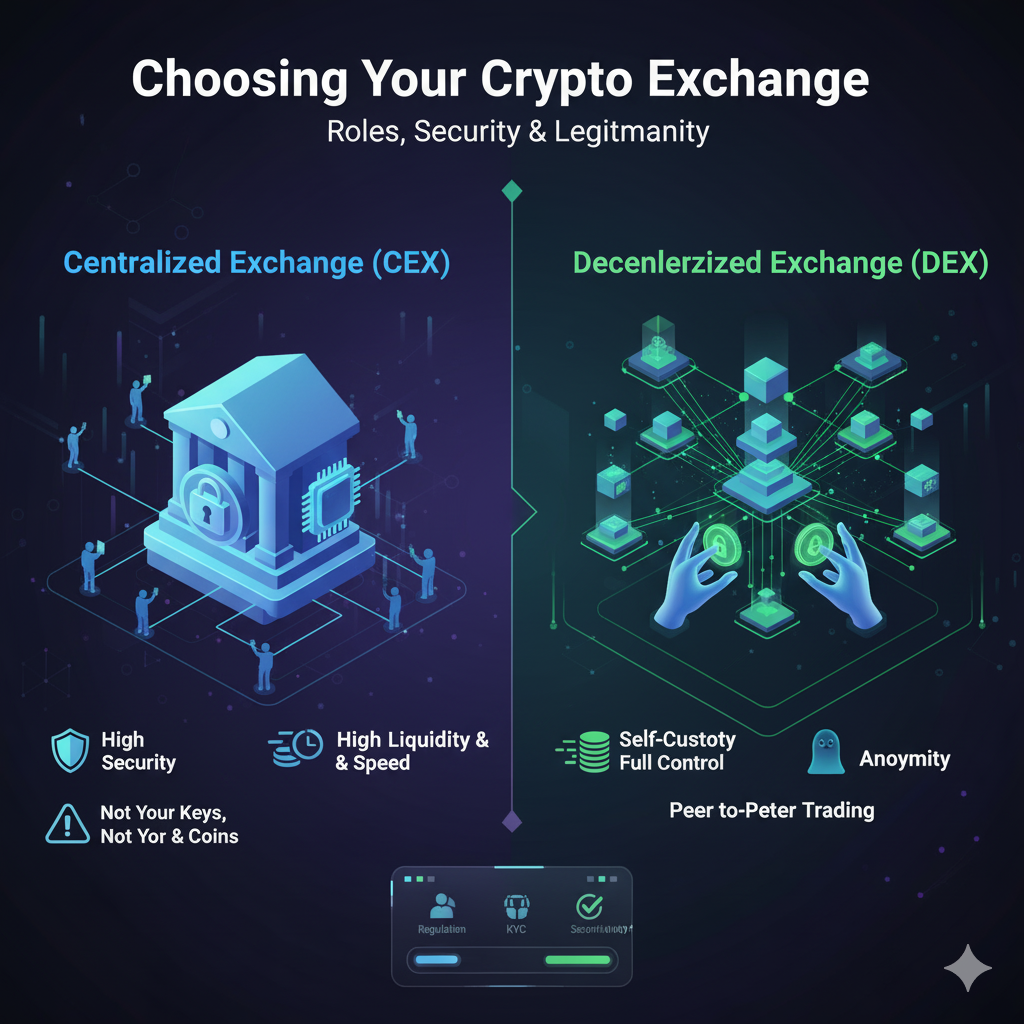
1. Centralized Exchanges (CEX): These are the most common type of exchange, operated by a single company (e.g., Binance, Coinbase, Kraken). They act as intermediaries and custodians of your funds.
- Pros: They are generally user-friendly, offer high liquidity, fast transaction speeds, and provide familiar services like customer support and a wide range of trading pairs.
- Cons: Because they hold your funds, they are a single point of failure and a prime target for hackers. The popular crypto saying, “not your keys, not your coins,” serves as a stark warning about the custodial risk associated with CEXs.
2. Decentralized Exchanges (DEX): DEXs operate without a central authority. They are peer-to-peer platforms that use smart contracts to facilitate trades directly between users’ wallets.
- Pros: DEXs eliminate custodial risk as you retain full control of your private keys and funds. They offer greater privacy and censorship resistance, as they do not require user information for trading.
- Cons: They can be more complex for beginners, and they may have lower liquidity and slower transaction speeds compared to their centralized counterparts.
Determining an Exchange’s Legitimacy
The crypto space has been a breeding ground for scams. Before trusting any platform with your funds, look for these key indicators of a legitimate exchange:
- Regulatory Registration: Reputable exchanges are registered with financial authorities in the countries where they operate (e.g., FinCEN as a Money Service Business in the U.S.).
- Verifiable Information: A legitimate exchange will have a transparent business address, a functioning phone number for customer service, and a verifiable history of operation.
- Security Measures: Look for robust security protocols, including two-factor authentication (2FA), cold storage for a majority of user funds, and a public history of security audits.
- No Guaranteed Returns: Be extremely wary of any platform that promises guaranteed returns on your investment. This is a common red flag for Ponzi and other fraudulent schemes.
The Evolving Landscape of Regulation in 2025
Regulation is no longer a fringe topic; it’s a driving force in the crypto industry. In 2025, governments and international bodies are creating clearer frameworks to protect investors and prevent illicit activity.
- US and EU Clarity: We’re seeing a shift towards more balanced regulations. In the U.S., new laws are providing a clear framework for exchanges, while the EU’s MiCA framework is forcing platforms to obtain licenses and adhere to strict compliance standards.
- Global Harmonization: International bodies like the G20 and the Financial Stability Board are working to harmonize crypto rules globally, creating a more consistent and secure environment for cross-border transactions.
In conclusion, cryptocurrency exchanges are an essential part of the digital asset ecosystem. By understanding the differences between centralized and decentralized platforms, and by carefully vetting their legitimacy and security measures, you can make informed decisions and better protect your investments in this rapidly evolving market.
Disclaimer: This article is for informational purposes only and is not financial advice. Cryptocurrency investments are highly volatile and speculative. We recommend you conduct your own research and consult a financial professional before making any investment decisions.