
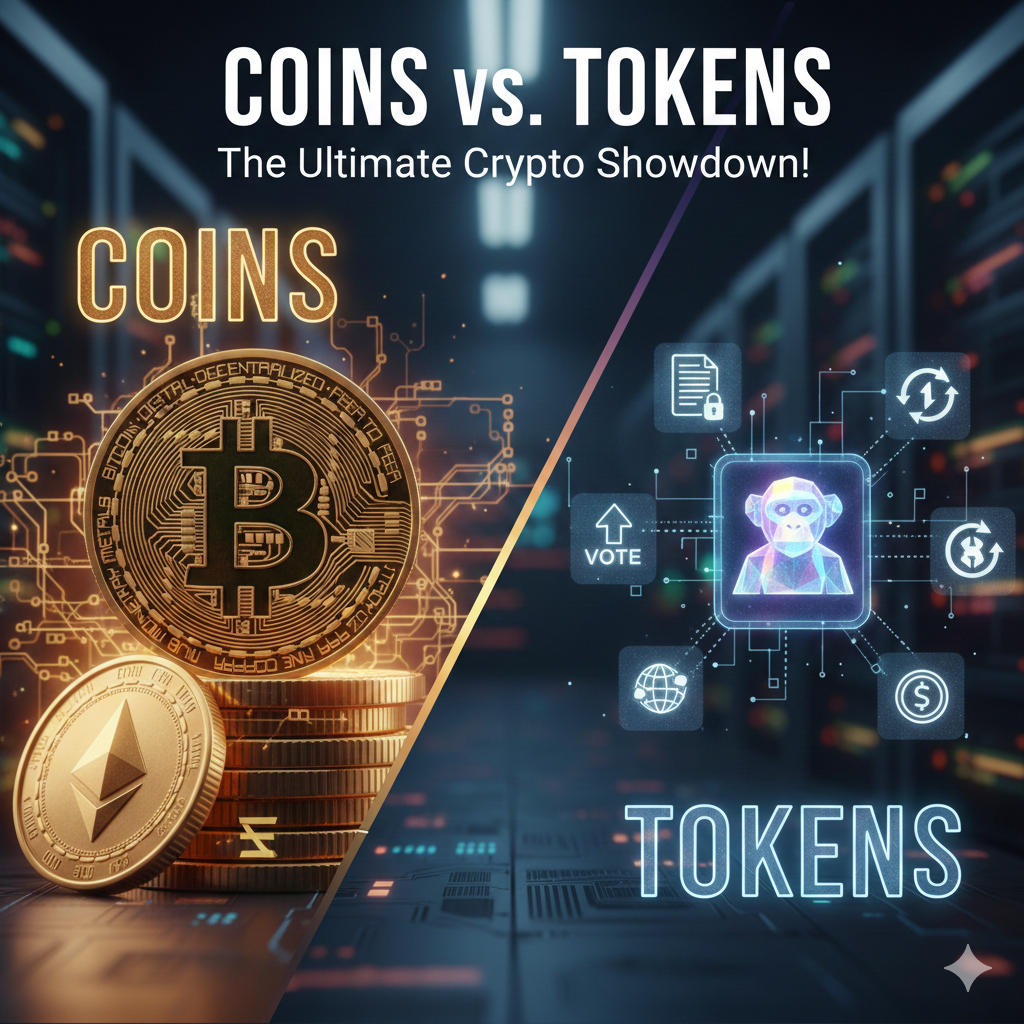
Confused about the difference between a crypto coin and a crypto token? You’re not alone. While often used interchangeably in casual conversation, these two digital assets are fundamentally distinct, each playing a critical and unique role in the decentralized world.
Thank you for reading this post, don't forget to subscribe!
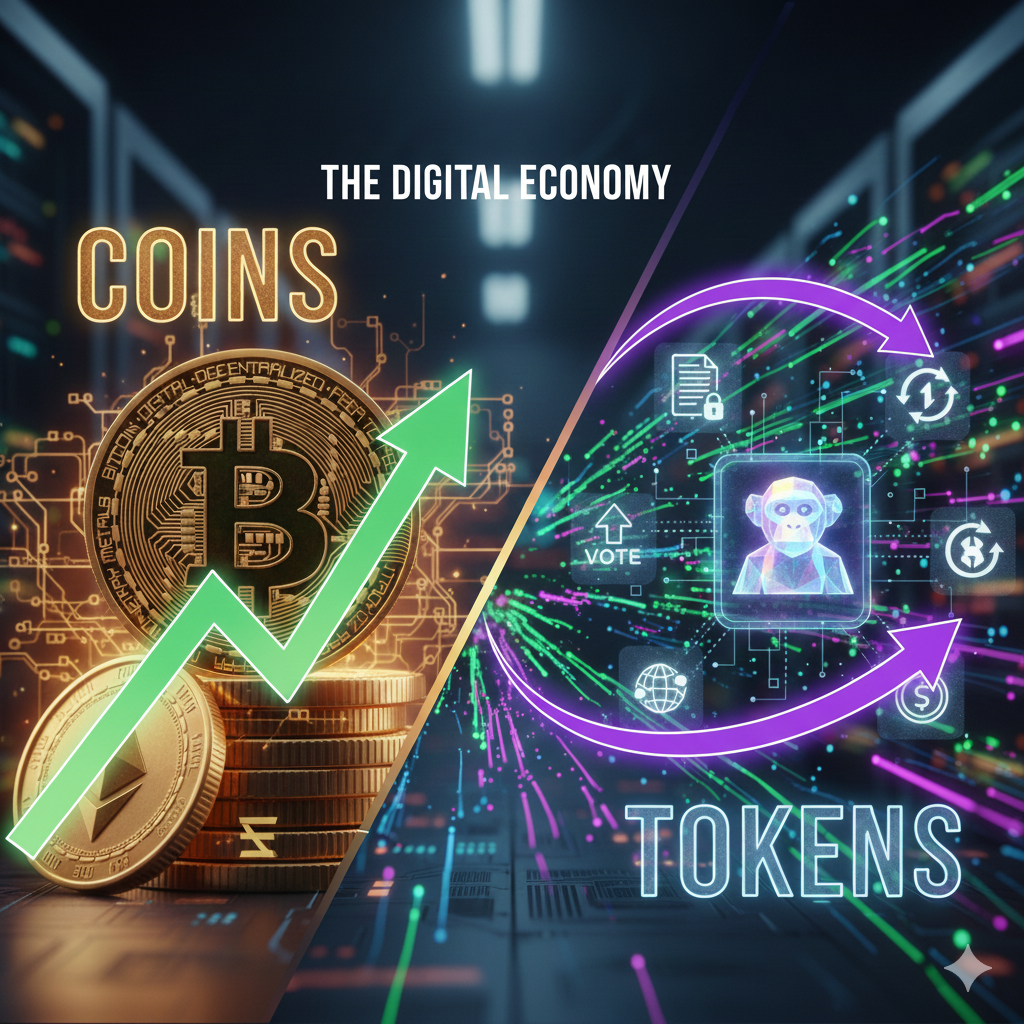
Understanding this difference is essential, whether you’re an investor, a developer, or just curious about the blockchain space. Let’s dive into the core distinctions, use cases, and answer the big question: which one is “better”?
🧐 What’s the Core Difference? The Blockchain Divide
The primary distinction between a crypto coin and a crypto token boils down to where they live and what they’re used for.
Crypto Coins: The Native Currency 💰
A crypto coin is a digital asset that is native to its own, independent blockchain. It is the lifeblood and foundational asset of that network.
- Independent Blockchain: Coins have their own dedicated ledger, consensus mechanism, and set of rules. They are the base layer of their ecosystem.
- Primary Utility: Coins primarily serve as a medium of exchange (digital money) and a store of value. They are also used to pay for transaction fees (often called “gas”) and incentivize miners/validators to secure the network.
- Examples: Bitcoin (BTC) on the Bitcoin blockchain, Ether (ETH) on the Ethereum blockchain, Litecoin (LTC)on the Litecoin blockchain, and Solana (SOL) on the Solana blockchain.
Crypto Tokens: The Flexible Asset 🎫
A crypto token is a digital asset that is built on top of an existing blockchain using smart contracts. They are not native to the network they run on; they leverage the host chain’s infrastructure for security and functionality.
- Host Blockchain: Tokens rely on an established Layer-1 blockchain (like Ethereum, Solana, or BNB Chain) for their creation, security, and transaction validation.
- Primary Utility: Tokens are designed for much broader applications than just currency. They represent a wide variety of assets, rights, or utilities within a specific project’s ecosystem.
- Creation: Tokens are far easier and cheaper to create than a coin, often deployed using standardized templates like ERC-20 (for fungible tokens) or ERC-721 (for Non-Fungible Tokens/NFTs) on Ethereum.
- Examples: USDC (a stablecoin on Ethereum), UNI (the governance token for Uniswap), and any NFT (digital art, collectibles, etc.).
| Feature | Crypto Coin | Crypto Token |
| Blockchain | Has its own, independentblockchain. | Built on top of an existing blockchain (via smart contracts). |
| Primary Purpose | Medium of exchange, store of value, network security. | Represents an asset, utility, ownership, or governance right. |
| Creation Difficulty | Complex (requires building an entirely new blockchain). | Simpler (requires deploying a smart contract on an existing chain). |
| Gas/Fees | Used to pay for transaction fees on its own network. | Gas fees are paid using the host chain’s native coin (e.g., ETH for an ERC-20 token transfer). |
| Examples | Bitcoin (BTC), Ethereum (ETH), Cardano (ADA). | USDC, Chainlink (LINK), NFTs, Governance tokens. |
🛠️ The Use Cases: What Can They Actually Do?
Both coins and tokens are indispensable, but their applications are specialized.
Use Cases for Crypto Coins
Coins are focused on forming the foundation of the decentralized economy:
- Digital Currency: The most basic use—sending and receiving value across the internet without intermediaries. (e.g., Bitcoin).
- Network Security: Used to incentivize participants (miners or validators) to secure the blockchain through mechanisms like Proof-of-Work (PoW) or Proof-of-Stake (PoS). (e.g., ETH, SOL).
- Base Layer of DeFi: Providing the core unit of value that allows tokens and Decentralized Finance (DeFi) applications to function.
Use Cases for Crypto Tokens
Tokens are the engine of innovation, bringing endless possibilities to the digital realm:
- Utility Tokens: Grant users access to a product or service within a platform. (e.g., Basic Attention Token (BAT)used to tip content creators on the Brave browser).
- Governance Tokens: Give holders voting rights on proposals that affect the future of a decentralized project or DAO (Decentralized Autonomous Organization). (e.g., UNI, AAVE).
- Security/Asset-Backed Tokens: Represent ownership of an external, often real-world asset, such as real estate, company shares, or gold. This is the heart of Tokenization.
- Non-Fungible Tokens (NFTs): Represent unique, non-interchangeable digital or physical items, such as art, music, or in-game assets.
- Stablecoins: Tokens pegged to the value of a fiat currency (like the US Dollar) to reduce volatility. (e.g., USDC, Tether (USDT)).
🥇 Which is “Better”: Coin or Token?
The simple answer is: Neither is inherently better; they serve different, complementary purposes.
- Coins are the Foundation: They are designed to be the robust, secure, and decentralized monetary backbone of a system. Building a coin is harder, but the result is a fully sovereign and self-sustaining network.
- Tokens are the Application Layer: They offer flexibility, versatility, and ease of creation. Tokens allow developers to focus on building innovative applications (dApps) without the massive undertaking of launching a whole new blockchain.
For investors, a well-diversified portfolio often includes both. Coins provide exposure to the core blockchain infrastructure, while tokens offer a chance to invest in specific applications, services, and future trends like DeFi, NFTs, and gaming.
In the evolving world of crypto, both coins and tokens are essential pillars. Coins provide the fundamental security and value transfer, while tokens build the rich, diverse ecosystem of digital assets and decentralized services that make the blockchain truly revolutionary.
Do you have a favorite crypto coin or a tokenized asset you find revolutionary? Share your thoughts below!
Want to learn more about a specific type of token, like Governance or NFTs?