Discover how crypto burning works and why it drives scarcity. See the total USD value burned by Ethereum, BNB, XRP and Shiba Inu today
Thank you for reading this post, don't forget to subscribe!
🔥 The Crypto Burning Mechanism: An Economic & Technical Deep Dive
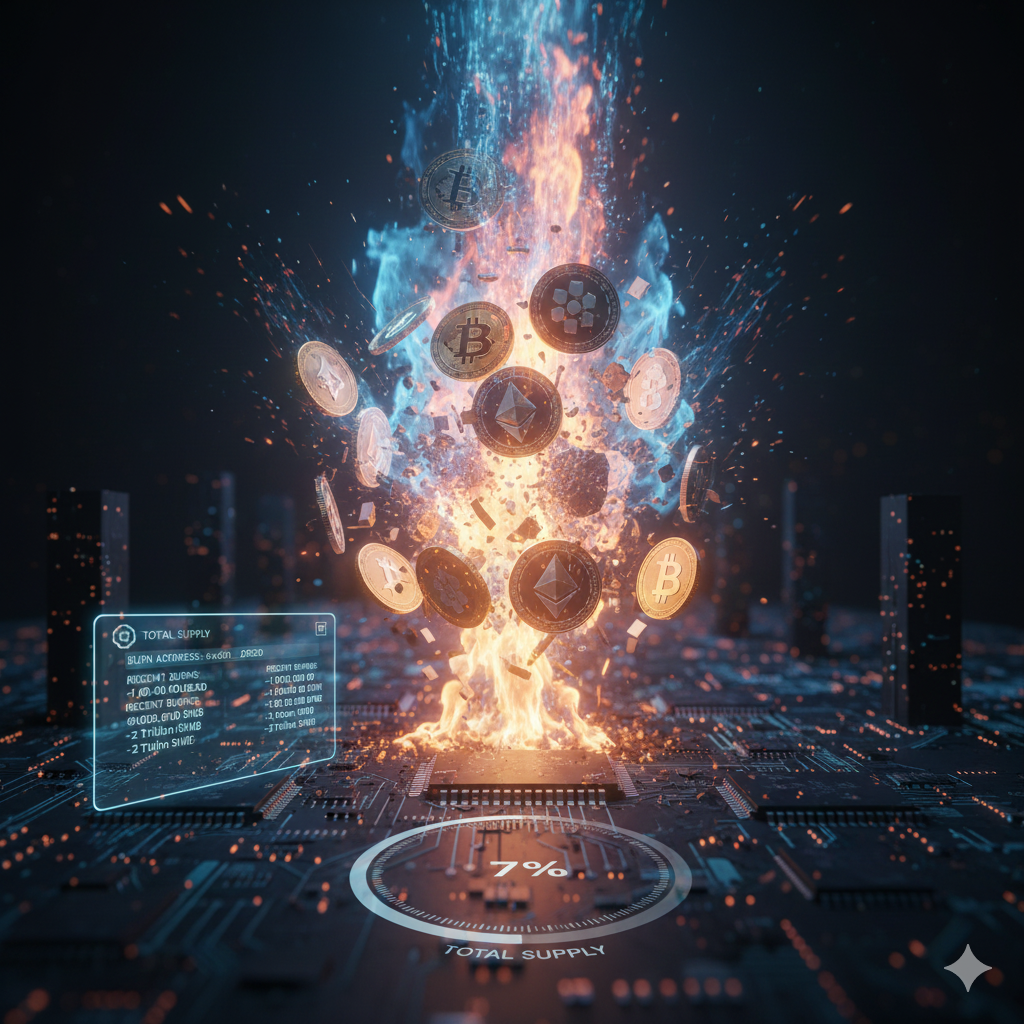
The burning mechanism is the programmatic act of permanently removing tokens from a cryptocurrency’s total supply. Its goal is to create deflationary pressure by reducing scarcity, which—under constant or increasing demand—theoretically supports an upward price trend.
Technical Explanation (The “Black Hole” Address)
Burning is an irreversible, verifiable action executed directly on the blockchain:
- The Burn Address: Tokens designated for burning are sent to a pre-determined, public wallet address. This address is often called an “Eater Address” or “Black Hole” address.
- Key Inaccessibility: Crucially, no private key exists for this burn address. Without a private key, the tokens are cryptographically locked and can never be moved, spent, or recovered by anyone, including the project team.
- On-Chain Verification: The transaction is visible on the network explorer. The difference between the initial total supply and the current total supply provides a precise, unalterable record of all tokens burned.
Circulating Supply=Initial Supply−Total Burned Tokens
Economic Rationale (Supply Shock)
The burning mechanism is the digital equivalent of a stock buyback and is employed to solve specific economic problems:
- Scarcity Driver: It directly impacts the supply side of the token’s economics. If a project reduces supply by 10% and demand remains stable, the value of the remaining 90% must adjust to compensate.
- Inflation Counter: Many Proof-of-Stake (PoS) blockchains are inherently inflationary due to staking rewards. Burning a portion of transaction fees (like Ethereum does) serves as an effective counter-inflationary measure, often leading to a net-deflationary supply during periods of high network activity.
- Security & Anti-Spam: By burning transaction fees (e.g., XRP), the cost of conducting transactions rises slightly, deterring malicious actors from spamming the network with thousands of low-value, pointless transactions.
📊 Major Coins Actively Burning Tokens (November 2025)
The most significant burning mechanisms are employed by major Layer 1 blockchains and ecosystem tokens due to their high transaction volume and institutional utility.
1. Ethereum (ETH)
Ethereum’s deflationary mechanism is the most technologically sophisticated.
- Mechanism: EIP-1559 Fee Burning (since August 2021).
- How it Burns: With every transaction, a mandatory base fee is paid and automatically destroyed by the protocol. Only the “priority fee” (tip) goes to the validators.
- Technical Impact: This burn is highly correlated with network activity. During periods of high demand (e.g., major NFT launches or DeFi volatility), the burn rate often exceeds the issuance rate (rewards to validators), making ETH supply net-deflationary.
- Worth Burned (Est. as of Nov 2025): Over 4.5 million ETH has been burned since EIP-1559. Valued conservatively at an estimated average price, the total value destroyed is likely over $15 billion USD.
2. Binance Coin (BNB)
BNB employs a hybrid burn mechanism tied to both centralized and decentralized activity.
- Mechanism: Auto-Burn (Quarterly) and Real-Time Gas Fee Burn (BEP-95).
- How it Burns:
- Auto-Burn: The BNB Foundation conducts quarterly burns. The amount is determined by a formula based on BNB’s price and the number of blocks produced on the BNB Smart Chain (BSC), ensuring predictability and transparency.
- BEP-95: A portion of the gas fees spent by users on the BNB Smart Chain is burned in every block.
- Technical Target: The goal is to continuously reduce the total supply from 200 million down to 100 million BNB.
- Worth Burned (Est. as of Nov 2025): The BNB Foundation’s most recent burns (33rd quarterly burn) were valued at over $1.2 billion USD (at the time of the burn). Historically, the total amount burned is over 65 million BNB, valued at well over $50 billion USD cumulatively, moving the circulating supply closer to its 100M hard target.
3. XRP (Ripple)
- Mechanism: Transaction Fee Burn
- How it Works: A small amount of XRP is destroyed (burned) with every transaction executed on the XRP Ledger. This is primarily an anti-spam mechanism to prevent the network from being overloaded with low-value transactions, but it also creates a slow, continuous deflationary effect on the supply.
3. Shiba Inu (SHIB)
SHIB’s burn mechanism is crucial for managing its massive initial supply.
- Mechanism: Shibarium L2 Fee Burn and Community-Driven Burns.
- How it Burns: The launch of the Shibarium Layer 2 network provided a consistent, automated mechanism: a portion of the transaction fees generated on Shibarium are converted into SHIB and then burned. This is supplemented by high-volume community and ecosystem (ShibaSwap) burns.
- Technical Impact: Given the initial supply of 1 quadrillion tokens, SHIB requires astronomical burn rates to meaningfully impact the circulating supply and price. Recent data has shown high volatility in the daily burn rate (spikes of over 20,000% are common), but the total supply remains extremely high.
- Worth Burned (Est. as of Nov 2025): The total SHIB burned since inception is over 410 trillion SHIB. While this is a massive number of tokens, due to the low price, the cumulative USD value destroyed is comparatively lowerthan ETH or BNB, and the impact on the currently circulating supply (around 589T) is incremental.
4. Solana (SOL)
Solana uses a straightforward fee-based burn.
- Mechanism: Transaction Fee Burn.
- How it Burns: A fixed percentage of the transaction fees paid on the Solana network is automatically burned, similar to the anti-spam purpose of XRP and the partial burn of ETH. This ensures that every successful transaction slightly reduces the SOL supply.
📈 Technical Analysis of Burn Mechanisms
When analyzing a token burn, a professional looks beyond the headline dollar value and focuses on the burn-to-issuance ratio and the long-term model.
| Metric | Deflationary Impact Score (1-5, 5=Highest) | Technical Analysis |
| Ethereum (ETH) | 5/5 | True Protocol Deflation: EIP-1559 creates a dynamic supply model where the burn rate can exceed the issuance rate (validator rewards). This is the gold standard for protocol-level deflation and is tied directly to network utility. |
| BNB (BNB) | 4/5 | Hybrid Deflation: The combination of quarterly Auto-Burn (guaranteed reduction towards 100M target) and the real-time Gas Fee Burn ensures reliable, predictable supply reduction linked to both the centralized exchange and the decentralized chain activity. |
| Shiba Inu (SHIB) | 3/5 | Relative Impact Challenge: While the absolute number of tokens burned is huge (trillions), the burn rate is still a small fraction of the total circulating supply. The effectiveness is highly dependent on the sustained, high-volume adoption of the Shibarium Layer 2 network. |
The crucial takeaway: A successful burn mechanism is one that is consistent, predictable, and directly correlated with the economic utility of the token. Ethereum and BNB demonstrate this best, as their burns are fundamentally tied to network usage, ensuring that as the ecosystem grows, the token supply tightens.