

Unpack the mystery of falling altcoin prices. Discover the key reasons behind their current downturn and get insights into when these digital assets might finally break new All-Time Highs, mirroring Bitcoin’s journey .
Thank you for reading this post, don't forget to subscribe!
Altcoin Enigma: Why the Dip & When Will They Soar Past ATH?
The world of cryptocurrency is a rollercoaster of emotions, and if you’ve been watching your altcoin portfolio, you might be feeling more “down” than “up” lately. While Bitcoin (BTC) seems to be regaining its footing, many altcoins continue to struggle, often hitting new lows. Why is this happening, and more importantly, when can we expect these digital assets to finally join the party and reclaim their All-Time Highs (ATHs)?
Let’s dive into the core dynamics at play.
The Downward Spiral: Why Altcoins Keep Dropping
Understanding the “why” is crucial to navigating the crypto market. Several interconnected factors contribute to the persistent decline in altcoin prices:
- Bitcoin’s Gravitational Pull (and Dominance): When Bitcoin sneezes, altcoins catch a cold – often a severe one. BTC remains the market leader, and its price movements heavily influence the entire crypto ecosystem. In a downturn, capital tends to flow out of riskier altcoins and into Bitcoin, seeking relative safety. This phenomenon, known as Bitcoin Dominance, means that even if BTC is consolidating, altcoins can still bleed heavily as investors de-risk.
- Risk Aversion and Macroeconomic Headwinds: The broader economic landscape plays a massive role. High inflation, rising interest rates, geopolitical instability, and a general “risk-off” sentiment in traditional markets directly impact crypto. Altcoins, especially smaller ones, are perceived as higher-risk assets. When fear grips the market, investors dump these speculative holdings, moving into more stable assets like stablecoins or even traditional cash, causing prices to plummet.
- Liquidity Drought and Cascading Liquidations: Many altcoins have significantly lower trading volumes compared to Bitcoin or Ethereum. This “thin liquidity” means that even relatively small sell orders can have a disproportionately large impact on price. Furthermore, in a volatile market, traders using leverage (borrowed funds) on altcoins face a constant threat of liquidation. As prices fall, their leveraged positions are automatically closed by exchanges, forcing more selling onto the market and accelerating the downward trend. This can create a brutal feedback loop, pushing prices to new lows with alarming speed.
- Survival of the Fittest: Project Fundamentals Under Scrutiny: Bull markets are fertile ground for hype-driven projects, but bear markets are a harsh reality check. Investors become far more discerning, scrutinizing the actual utility, development progress, community support, and financial health of altcoin projects. Those built on shaky foundations or lacking real-world use cases tend to lose investor confidence entirely, leading to continuous sell-offs. Many projects simply don’t survive a prolonged bear market, and their tokens reflect that grim reality by hitting successive new lows.
When Will Altcoins Soar Past Their ATHs? The Road to Recovery
The question on every altcoin holder’s mind: when will the bull run return, ushering in a new “Altseason” where their assets reclaim and surpass previous ATHs? While no one has a crystal ball, historical market cycles and current analysis offer some strong indicators:
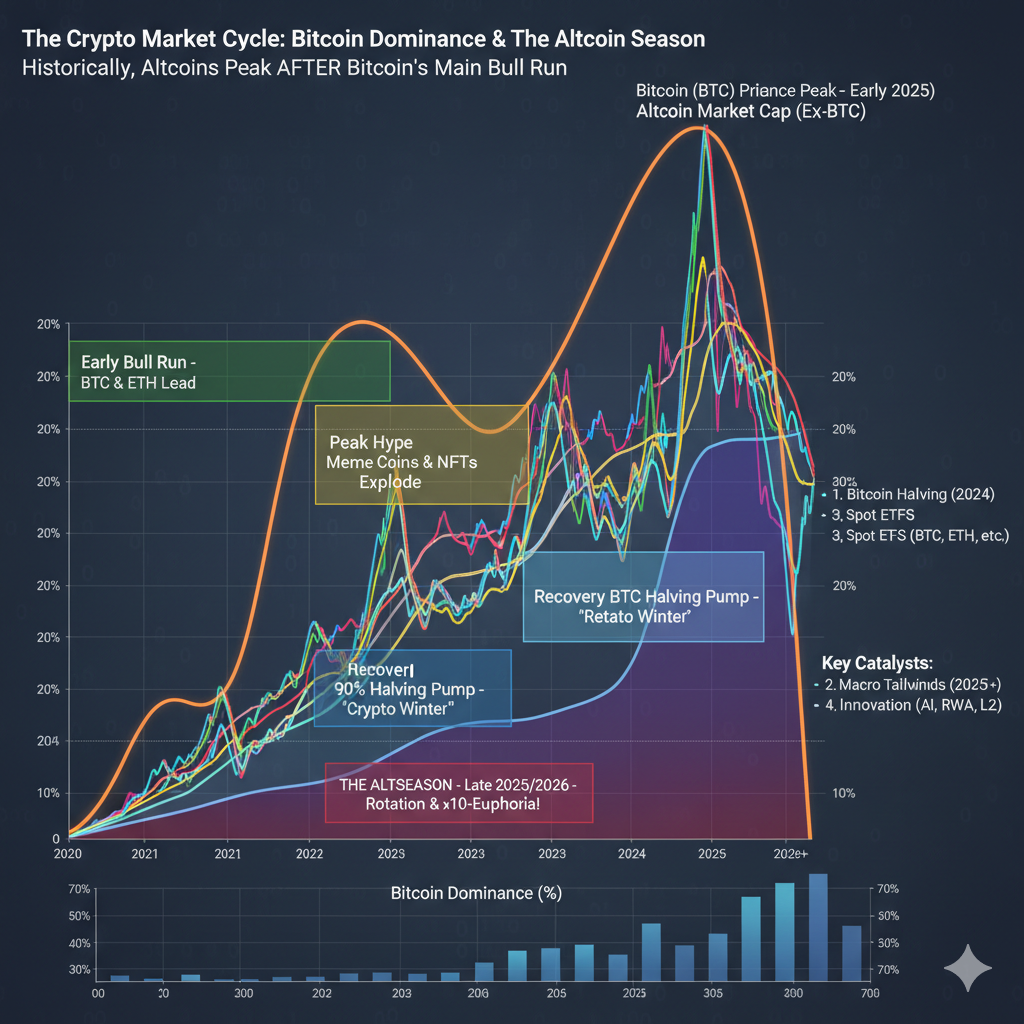
- Bitcoin Leading the Charge (First): Historically, Bitcoin initiates the major bull market. It undergoes its own significant price discovery, often hitting new ATHs first. This generates excitement and draws new capital into the crypto space. It’s only after Bitcoin has made its big moves and starts to consolidate that investors begin to rotate profits into Ethereum, and then eventually into a broader range of altcoins.
- The Halving Cycle’s Influence (2024 & Beyond): The Bitcoin halving event (the most recent was in April 2024) significantly reduces the supply of new Bitcoin. Historically, this event has been a precursor to major bull runs, with the most explosive price action typically occurring 12-18 months after the halving. This suggests that the latter half of 2025 and into 2026 could be the sweet spot for a full-blown crypto bull market, including a vibrant Altseason.
- Declining Bitcoin Dominance (The Key Indicator): A crucial signal for Altseason is a sustained decline in Bitcoin Dominance. This indicates that money is flowing out of BTC and into altcoins. When you see BTC trading sideways or even pulling back slightly, while altcoins begin to surge, that’s a strong sign the market is entering its altcoin-focused phase.
- Macroeconomic Improvement & New Liquidity: A more favorable macroeconomic environment – such as declining inflation, interest rate cuts, and increased investor confidence in risk assets – will be a significant catalyst. Furthermore, the entry of new institutional money (e.g., through more Spot ETFs for Ethereum or other major altcoins) will bring fresh liquidity that can fuel broad market rallies.
- Innovation and Narrative-Driven Surges: Even before a full Altseason, specific altcoin sectors can experience mini-bull runs driven by innovation or strong narratives. Projects in areas like Artificial Intelligence (AI), Real-World Assets (RWAs), Layer 2 scaling solutions, or decentralized finance (DeFi) could see significant pumps as new developments and partnerships emerge. These can be precursors to the broader market shift.
What Does This Mean for Your Portfolio?
Patience is often the most rewarded virtue in crypto. While seeing your altcoins hit new lows can be disheartening, understanding the underlying market dynamics provides context. The next major Altseason is likely tied to the broader Bitcoin halving cycle and an improvement in global financial conditions.
The period after Bitcoin’s initial major run-up, often in the year following a halving, is historically when altcoins shine brightest and have the potential to reclaim and far surpass their previous All-Time Highs. Until then, focused research on projects with strong fundamentals and innovative solutions remains key.