
What are L1, L2, and L3 blockchains? Understand the base layer (Ethereum, Bitcoin), scaling solutions (Rollups, Sidechains), and the application layer that powers dApps.
Thank you for reading this post, don't forget to subscribe!
Welcome to CryptoDecodeing!
If you’ve spent any time at all in the crypto space, you’ve heard the technical chatter: “L1,” “L2,” “Rollups,” and “gas fees.” It can sound like a foreign language, but these terms are actually the blueprints for the internet’s future.
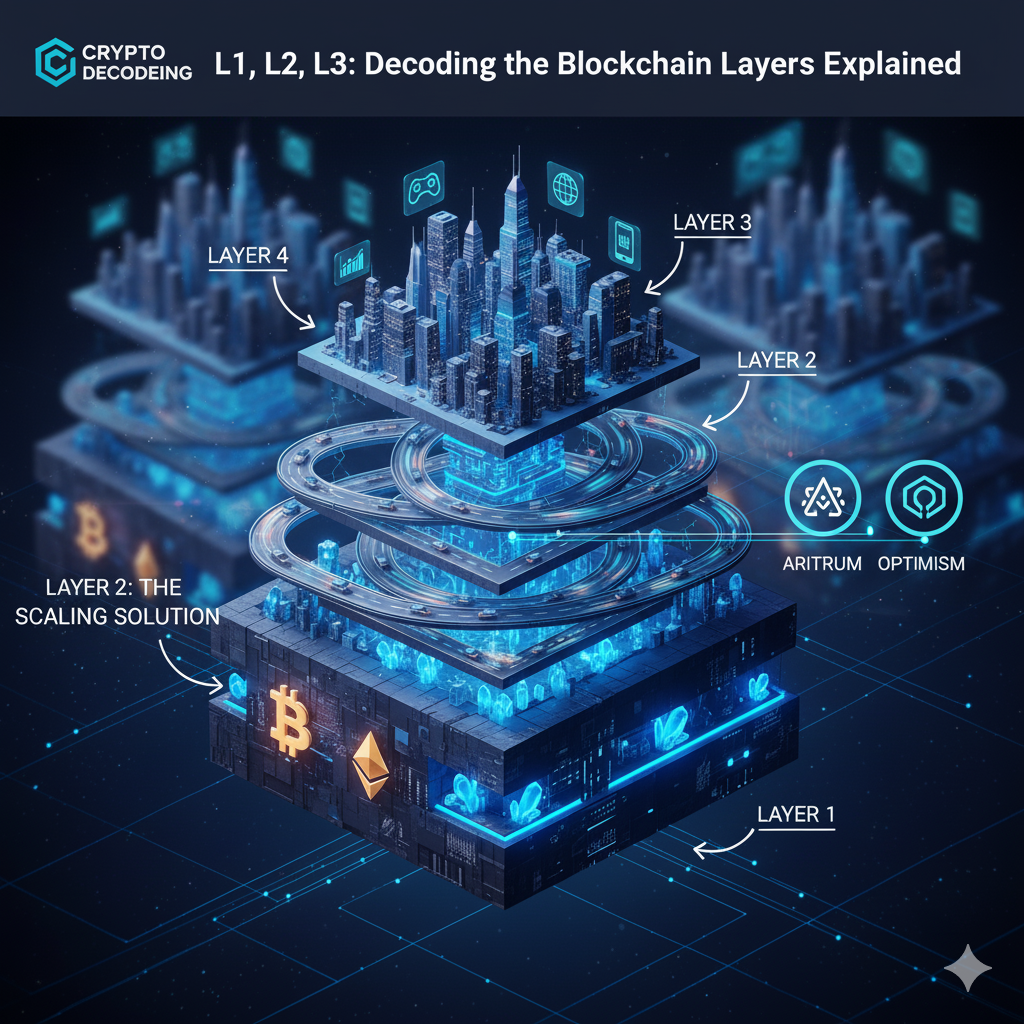
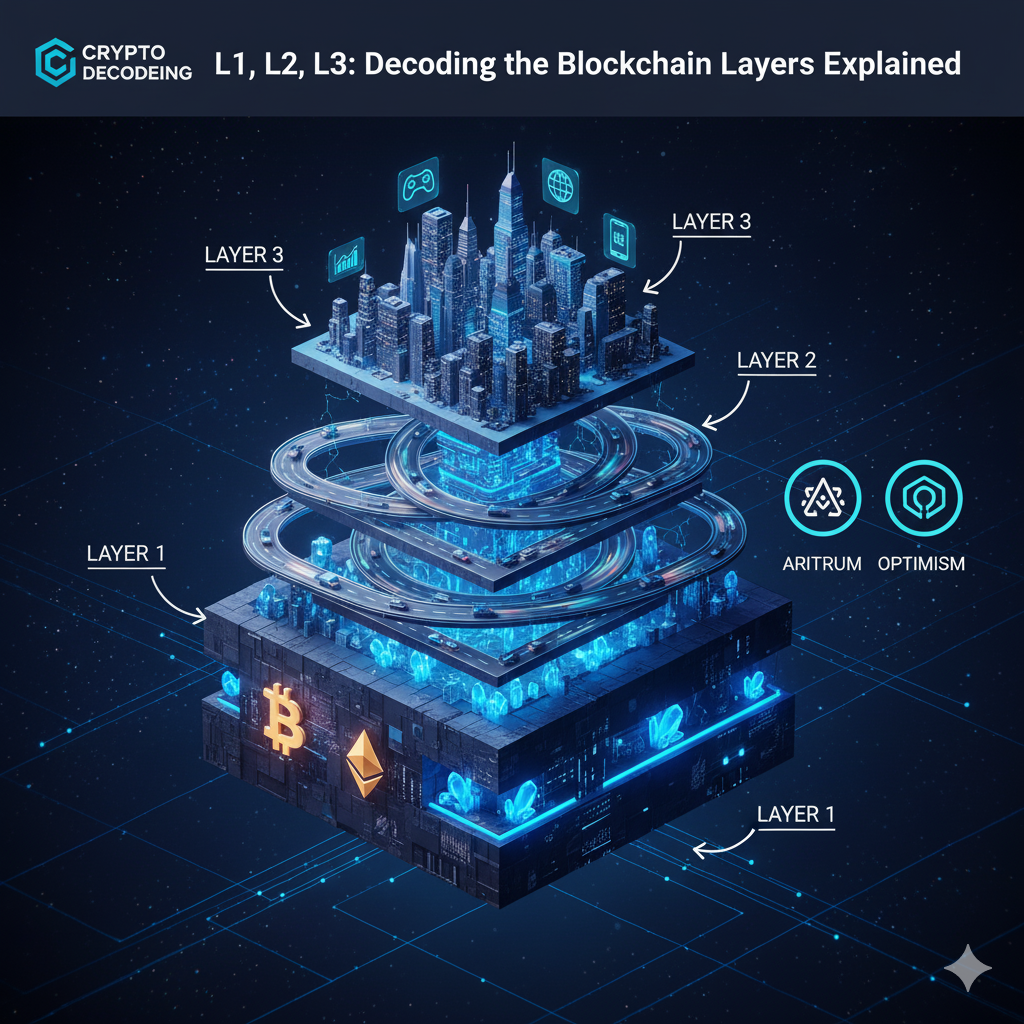
Think of the entire blockchain ecosystem like a major city. To handle all the people (users) and all the traffic (transactions), you need different levels of roads and infrastructure. You need highways, side streets, and local expressways.
That’s exactly how modern blockchains are built! They use a layered structure to tackle the biggest problem in crypto: the trade-off between security, decentralization, and speed.
Ready to decode the architecture? Let’s break down the three main layers of blockchain technology in the simplest way possible.
Layer 1 (L1): The Foundation and The Main Highway
Keywords: Layer 1 blockchain, L1 crypto, Bitcoin, Ethereum, base layer security, Proof-of-Work, Proof-of-Stake
Layer 1 is the base network. This is the original, main blockchain that handles the most important jobs: security and final settlement.
What L1 Does:
- The Core Rules: L1 sets the core rules for the entire network. This includes the consensus mechanism (like Proof-of-Work or Proof-of-Stake) that keeps the network honest and decentralized.
- Security Guarantee: When a transaction is recorded on Layer 1, it’s finalized. It’s written in stone, making L1 the ultimate “source of truth” and the most secure part of the system.
- Examples: Bitcoin and Ethereum (the original chain) are the most famous L1s. Others include Solana, Cardano, and Avalanche.
The L1 Problem: Slowing Down
L1 networks are built for maximum security and decentralization, which often means they are slow. When millions of people try to use an L1 network like Ethereum at the same time, it causes congestion (traffic jams). This drives up the cost of a transaction, known as the gas fee.
To solve this speed and cost problem, we need to move traffic to a different level. Enter Layer 2.
Layer 2 (L2): The Express Lane for Speed
Keywords: Layer 2 scaling, L2 solutions, Rollups, transaction speed, low gas fees, Arbitrum, Optimism
Layer 2 (L2) is a separate framework, or network, built on top of the Layer 1 chain. Its main goal is simple: scalability and speed without sacrificing the security of the L1.
How L2s Save the Day:
Imagine an express train running parallel to the main highway (L1). The train (L2) scoops up thousands of individual transactions, bundles them together, and processes them off the main highway. Then, it only sends a single, compressed “proof” back to the L1 for final verification.
- Faster Transactions: Because they process transactions in batches, L2s can handle thousands more transactions per second than the base L1.
- Lower Fees: Less competition for space on the main L1 means much lower fees for users on the L2.
Key L2 Technologies:
- Rollups: These are the most popular L2 solutions. They literally “roll up” transactions.
- Optimistic Rollups (e.g., Arbitrum, Optimism): They assume all transactions are honest but include a time window for others to challenge a fraudulent transaction.
- ZK-Rollups (e.g., zkSync, StarkNet): These use advanced math (Zero-Knowledge Proofs) to prove that a batch of transactions is valid before sending it to the L1.
- Sidechains (e.g., Polygon PoS Chain): These are independent, separate blockchains connected to the L1 via a secure bridge.
L2’s Secret Weapon: They inherit the security of the L1. Even though they are faster, they still benefit from the rock-solid security of the base chain.
Layer 3 (L3): The Application Layer for Users
Keywords: Layer 3 application, L3 interoperability, customized dApps, Web3 user experience, crypto monetization
If L1 is the foundation and L2 is the scaling express lane, then Layer 3 (L3) is the highly customized application layerwhere users actually interact with the system.
You can think of L3s as the specific, specialized apps built on top of the fast L2 network.
The Purpose of L3s:
- Extreme Customization: L3s allow developers to create ultra-optimized environments for specific applications. For example, a massive, fast-paced decentralized gaming platform (GameFi) or a highly-private data exchange might run best on a custom L3 chain.
- Interoperability: One of the emerging roles of L3 is to help different L2s talk to each other. This is crucial for creating a seamless experience where you can move your crypto or data between different apps without hassle.
- Web3 Experience: The L3 layer is all about the user experience (UX). It hides the messy complexity of the L1 and L2 layers, delivering super-fast, nearly free, and highly-tailored experiences directly to you.
Essentially, L3 is what finally makes decentralized apps feel as smooth and simple as using your favorite app on your smartphone.
The Big Picture: Why the Layers Matter for Investors
This layered approach isn’t just an interesting technical detail—it’s the engine for the next phase of Web3 growth.
| Layer | Function | Goal | Example (Ecosystem) |
| L1 | Base Network | Security & Decentralization | Bitcoin, Ethereum |
| L2 | Scaling Solution | Speed & Lower Fees | Arbitrum, Optimism, Polygon |
| L3 | Application | User Experience & Customization | A specific GameFi DApp built on an L2 |
As an investor or a crypto enthusiast, understanding this structure helps you evaluate projects:
- Security: Always starts with the L1. Is the L1 secure and decentralized?
- Potential: L2s unlock the potential of the L1. A great L2 can dramatically increase the value and utility of the underlying L1.
- Adoption: L3s drive real-world adoption by making the crypto experience seamless and fast.
The race to build the best, fastest, and most secure L2s and L3s is what’s fueling innovation and market growth today. Keep an eye on the projects that are building efficient connections across all three levels—that’s where the future of blockchain is being built.
Ready to Learn More?
Bookmark this page as your cheat sheet for blockchain layers! And for more insights on the latest L2 and L3 developments, be sure to subscribe to the CryptoDecodeing newsletter.
What are your favorite L2 solutions right now? Let us know in the comments!