
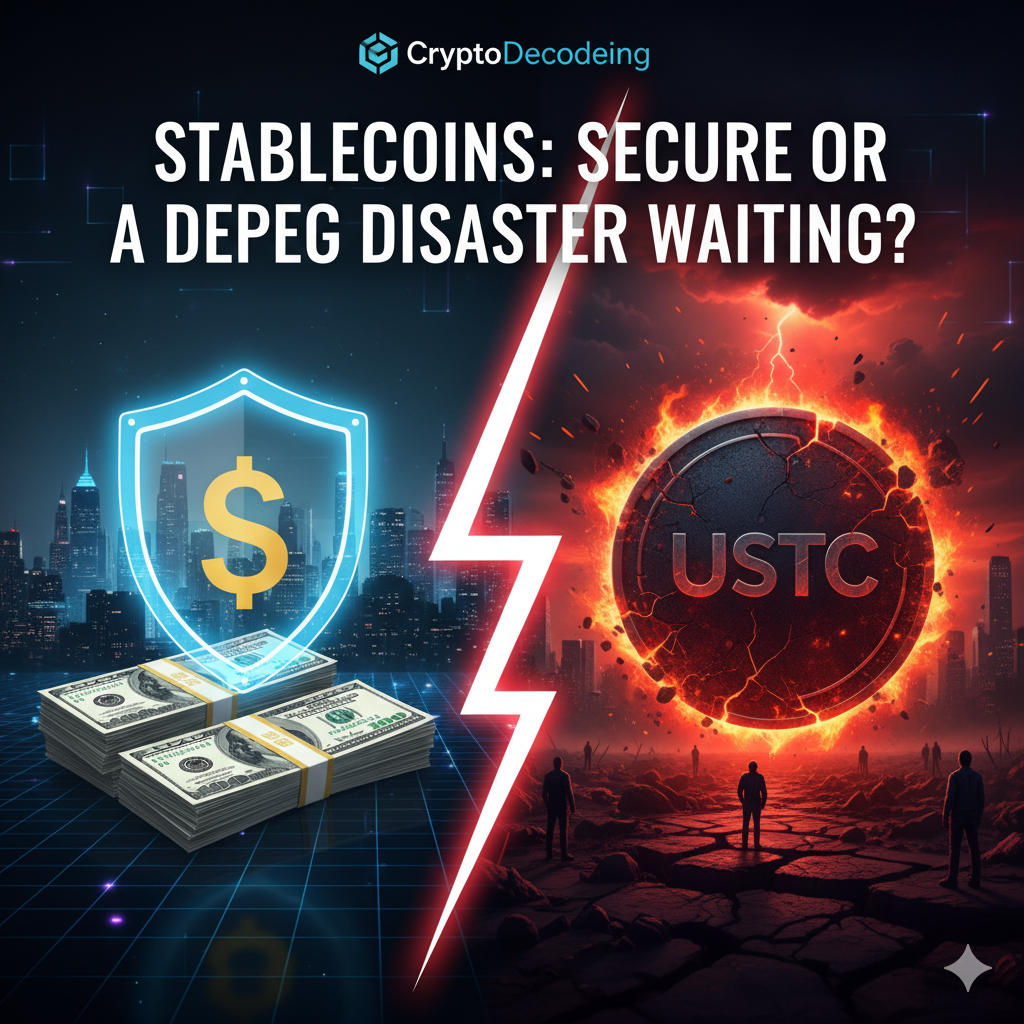
Are stablecoins safe? After UST’s crash, learn the risks of USDT, USDC, and more. Uncover how different stablecoins work and future depegging threats.
Thank you for reading this post, don't forget to subscribe!
Welcome back to CryptoDecodeing!
The world of cryptocurrency moves at warp speed, bringing incredible innovation alongside undeniable risk. Nowhere is this tension more apparent than with stablecoins – the digital assets designed to hold a steady value, typically pegged to the US Dollar.
For many, stablecoins are the safe haven in crypto’s stormy seas, the bridge between traditional money and decentralized finance. But the catastrophic collapse of TerraClassicUSD (USTC), formerly UST, and its sister token LUNA etched a brutal lesson into the minds of investors: not all stablecoins are created equal.
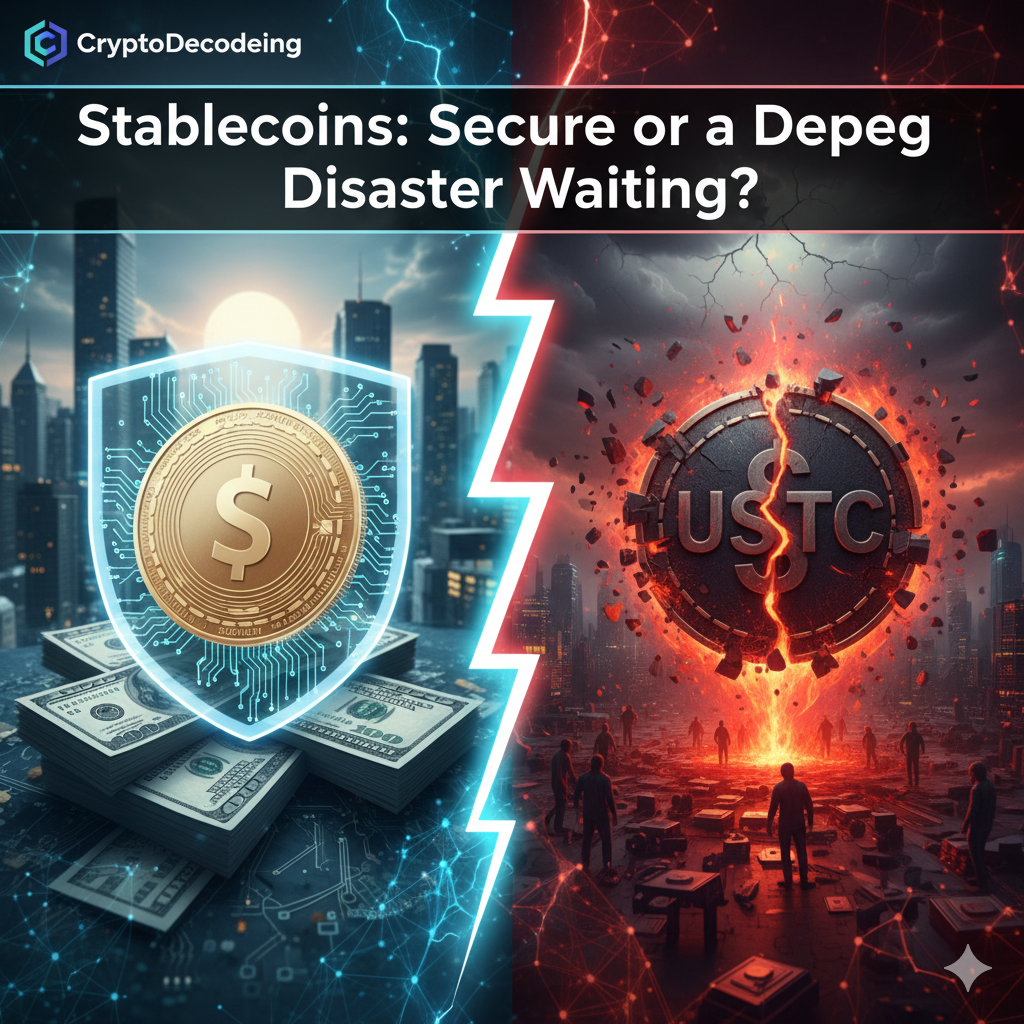
So, are stablecoins truly secure, or is another “depeg disaster” always just around the corner? Let’s decode the risks and realities.
The Promise of Stablecoins: Digital Stability
Keywords: stablecoin stability, crypto pegged to dollar, stablecoin use cases, reduce crypto volatility
Imagine trying to buy a coffee with Bitcoin if its price swings 10% in an hour. Impractical, right? Stablecoins solve this. They offer the speed and borderless nature of crypto with the price stability of fiat currencies.
Why are they so important?
- Trading: Easy entry and exit from volatile crypto markets without converting back to fiat.
- Payments: Ideal for everyday transactions, remittances, and cross-border payments.
- DeFi: Essential for lending, borrowing, and yield farming in decentralized finance protocols.
But this crucial stability isn’t magic. It comes from various backing mechanisms, and understanding them is key to assessing their safety.
The Three Types of Stablecoins: A Spectrum of Risk
Not every stablecoin works the same way. Their design dictates their strengths and, more importantly, their weaknesses.
1. Fiat-Collateralized Stablecoins: The Bank-Backed Giants
Keywords: USDC security, USDT risks, fiat-backed stablecoin, transparent reserves
These are the most common and generally considered the safest type.
- How They Work: For every stablecoin issued (e.g., 1 USDC), a company holds an equivalent amount of fiat currency (like USD) or highly liquid assets (like US Treasury Bills) in a traditional bank account. They promise a 1:1 redemption.
- Examples: USDT (Tether), USDC (USD Coin), PYUSD (PayPal USD).
- Key Risks:
- Reserve Transparency: Do they truly hold enough cash and equivalents? Lack of regular, full audits can be a concern.
- Centralization Risk: The reserves are held by a central entity, making them vulnerable to bank failures, regulatory pressure, or even poor management. (USDC briefly depegged when Silicon Valley Bank collapsed in 2023, showing this risk.)
2. Crypto-Collateralized Stablecoins: Decentralized but Over-Collateralized
Keywords: DAI stablecoin, over-collateralized crypto, decentralized stablecoin
These stablecoins aim for decentralization by using other cryptocurrencies as collateral, managed by smart contracts.
- How They Work: Users lock up more crypto than they borrow in stablecoins (e.g., $150 worth of Ethereum to mint $100 worth of stablecoin). This “over-collateralization” absorbs price drops in the backing asset.
- Example: DAI (from MakerDAO).
- Key Risks:
- Market Volatility: A sudden, massive crash in the price of the collateralized crypto can trigger cascading liquidations, potentially overwhelming the system.
- Smart Contract Risk: Bugs or exploits in the underlying code could put the collateral at risk.
3. Algorithmic Stablecoins: The Experiment That Failed (Spectacularly)
Keywords: USTC crash, LUNA collapse, algorithmic stablecoin risk, death spiral crypto
This category is where the infamous USTC disaster occurred. These stablecoins attempt to maintain their peg through complex mathematical algorithms and market incentives, without direct fiat or crypto collateral.
- How They Work: They typically use a dual-token system. If the stablecoin falls below its peg, an algorithm encourages users to burn the stablecoin to mint a volatile partner token (e.g., LUNA for USTC). If it goes above, the opposite happens. The idea is to adjust supply to match demand.
- Example: TerraClassicUSD (USTC), Ampleforth (AMPL).
- Key Risks: EXTREMELY HIGH.
- The “Death Spiral”: This is the fatal flaw. If market confidence is lost and people start selling the stablecoin en masse, the algorithm can be overwhelmed. The value of the partner token (LUNA) plummets, making it useless as a “backstop.” This creates a vicious cycle where both tokens crash towards zero.
The USTC/LUNA Catastrophe: A Warning to the World
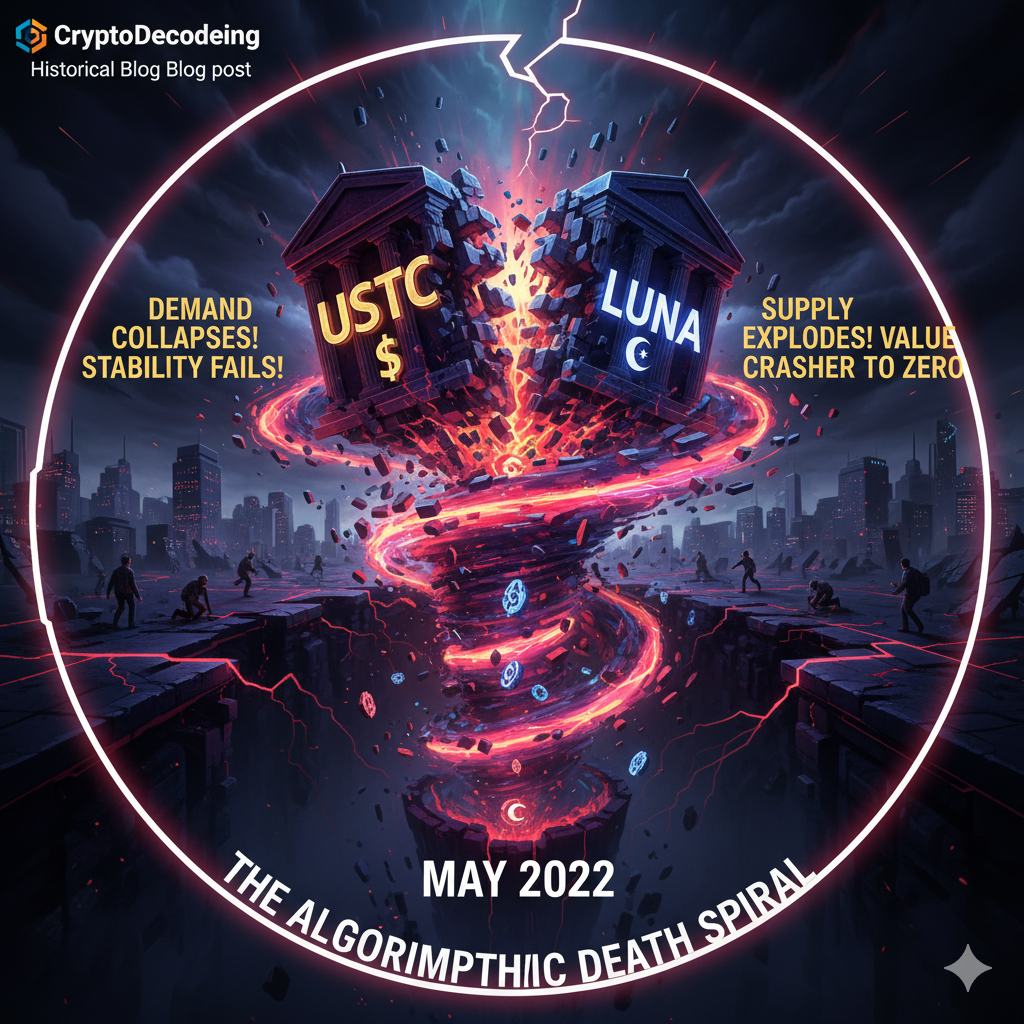
In May 2022, the crypto world watched in horror as TerraClassicUSD (USTC), then the third-largest stablecoin, lost its $1 peg. Within days, it plummeted to mere cents, taking its sister token, LUNA, from over $80 to virtually zero. Billions of dollars were wiped out.
How did it happen?
- Loss of Confidence: A large amount of USTC was sold, pushing its price slightly below $1.
- Algorithmic Weakness: The algorithm tried to restore the peg by letting users swap USTC for LUNA. This dramatically increased the supply of LUNA.
- The Death Spiral: As LUNA’s supply surged, its price crashed. This meant swapping USTC for LUNA became less effective, further destabilizing USTC. Panicked investors sold both tokens, creating a reinforcing downward spiral that the algorithm simply couldn’t combat.
This event exposed the extreme fragility of purely algorithmic designs, proving that without substantial, diversified collateral, market sentiment alone can trigger a complete meltdown.
Future Risks: Are USDT and USDC Safe?
Keywords: USDT depeg risk, USDC regulatory risk, stablecoin future, stablecoin regulation
The USTC crash didn’t signal the end of all stablecoins, but it certainly raised crucial questions about the stability of even the largest players.
- USDT (Tether): Has historically faced scrutiny over the composition and transparency of its reserves. While they have provided more attestations, fully audited reports are often delayed or incomplete. A sudden, massive withdrawal demand could stress their ability to maintain the peg if reserves aren’t as liquid as claimed.
- USDC (USD Coin): Generally considered the most transparent due to monthly attestations by an independent accounting firm. Its brief depeg during the Silicon Valley Bank collapse in 2023 was a stark reminder that even the most reputable fiat-backed stablecoins face risks tied to the traditional banking system. However, it quickly regained its peg, demonstrating robust underlying liquidity.
The Future: Regulation and Transparency
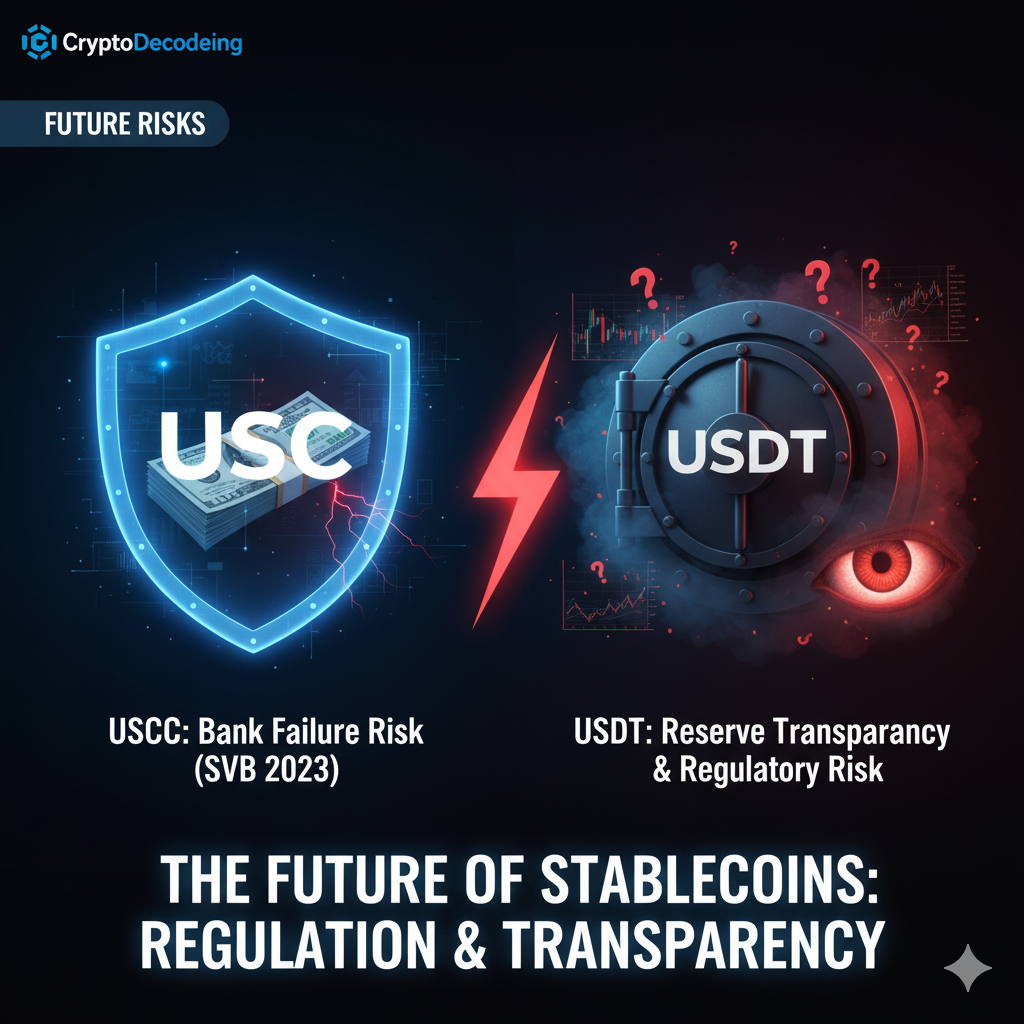
Regulators globally are now pushing for stricter rules around stablecoins, especially requiring proof of 1:1 reserves and regular, independent audits. This increased oversight aims to make fiat-backed stablecoins even safer.
While the fundamental risks of reserve management and traditional banking system exposure remain for USDT and USDC, they operate on a vastly different and generally more robust model than the failed algorithmic stablecoins.
Decoding Your Stablecoin Strategy
No investment is without risk. When evaluating stablecoins:
- Understand the Mechanism: Always ask: What backs this stablecoin? Fiat, crypto, or just an algorithm?
- Check Transparency: For fiat-backed, look for regular, reputable attestations or audits of their reserves.
- Diversify (if necessary): If you hold significant stablecoin value, consider spreading it across different fiat-backed options like USDC and USDT.
The USTC collapse was a painful but invaluable lesson. It didn’t invalidate the need for stablecoins, but it underscored the importance of due diligence and understanding the underlying mechanics. Choose wisely, and you can still leverage the stability they offer in the dynamic crypto landscape.