Don’t lose money to crypto scams. Learn the three types of rug pulls, 6 red flags, and essential steps to check for locked liquidity and smart contract safety.
Thank you for reading this post, don't forget to subscribe!
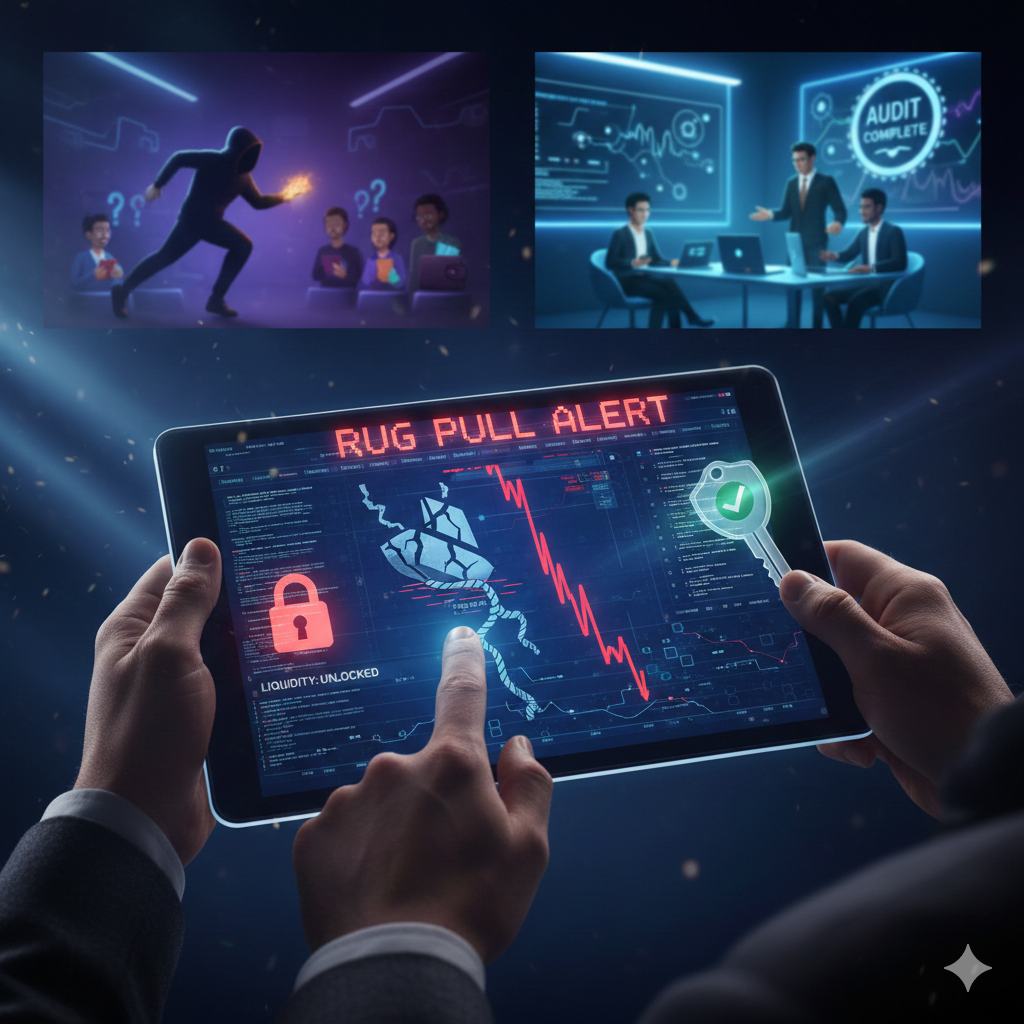
The world of decentralized finance (DeFi) is an innovation powerhouse, but it’s also a magnet for fraudsters. The term “rug pull” has become synonymous with instant, devastating losses, accounting for billions of dollars siphoned from investors in recent years.
A crypto rug pull is an exit scam where a project’s creators attract investment, often through social media hype and unrealistic promises, only to abruptly shut down and run away with the funds, leaving investors with entirely worthless tokens.
This is your essential, up-to-date guide on how rug pulls are executed and the critical steps you must take to safeguard your investments.
🔪 Understanding the Mechanics: Types of Crypto Rug Pulls
Rug pulls are not all the same. Scammers employ increasingly sophisticated tactics, but they generally fall into three categories:
1. Liquidity Pulls (The Hard Rug Pull)
This is the most common and damaging type. When a new token is launched on a decentralized exchange (DEX), developers create a Liquidity Pool (LP) by pairing their new token with a reputable asset like ETH or USDC. Investors buy the token, increasing the size of the LP.
The hard rug pull occurs when the developers, who still control the LP tokens, instantly withdraw all the ETH/USDCfrom the pool. This removes the collateral, causing the project token’s price to instantly crash to zero, as there is no value left to trade it for.
2. Dump and Sell (The Soft Rug Pull)
This is essentially a pump-and-dump scheme orchestrated by the project team. The developers mint themselves a massive supply of the token (e.g., 50% of the total supply). They use aggressive marketing to pump the price and attract retail buyers. Once the price reaches a high, the team slowly or suddenly sells off their enormous token holdings onto the open market. This selling pressure permanently destroys the price, and the developers walk away with the profit.
3. Honeypot Contracts (The Code Trap)
In this highly technical scam, the developers write malicious code into the token’s smart contract that allows anyone to buy the token, but only their own privileged wallet can sell it. When investors rush to buy the token, they find themselves unable to cash out, while the developers are free to sell at the peak price—effectively trapping the victim’s funds.
🚩 6 Red Flags to Spot a Potential Rug Pull
Thorough due diligence (DYOR) is the only shield you have. Look for these critical warning signs before you commit any funds:
| Red Flag | The Danger |
| Anonymous/Unverified Team | Developers use pseudonyms, AI-generated profile pictures, or lack a verifiable history in the crypto or tech space. No face, no funds. |
| Unrealistic, Guaranteed Returns | Promises of guaranteed 100x returns, fixed high APYs (Annual Percentage Yields), or low-risk/high-reward models that defy market logic. |
| No Liquidity Lock or Low Lock Time | The liquidity provider (LP) tokens are not locked or are locked for a very short period (e.g., one month). This allows the team to pull the liquidity at any moment. |
| Unaudited Smart Contract | The project’s code has not been formally reviewed and verified by a reputable third-party security firm (like Certik or PeckShield). |
| High Token Concentration | A small number of wallets (often the developers) hold a disproportionately large percentage of the total token supply (e.g., >20% in the top 10 wallets). |
| Aggressive, Bot-Driven Hype | The marketing is overwhelming, features low-quality influencers, and community chats are dominated by bots or aggressive shilling. Critics or questions are instantly banned. |
🛡️ How to Stay Safe: Your 5-Step Security Checklist
To protect yourself in the high-risk DeFi landscape, you must verify the project’s security fundamentals using on-chain data.
1. Verify the Liquidity Lock 🔒
This is the single most important step. You must confirm that the LP tokens are locked in a public vesting or time-lock contract.
- Action: Use reputable locking platforms like Unicrypt, DxSale, or Team Finance to check the status of the LP. Look for locks of at least 6-12 months or permanently burned LP tokens.
- Warning: If the developers can remove the liquidity at any time, do not invest.
2. Review the Smart Contract Audit 🔎
A professional audit ensures the code does not contain malicious functions (like a backdoor for draining funds or a selling restriction).
- Action: Check if the project has been audited by a top-tier firm. Critically, read the audit report itself, not just the summary. Were any critical vulnerabilities found and fixed? An unreviewed audit report is a red flag.
3. Analyze Token Distribution 📊
Check the blockchain explorer (like Etherscan, Solscan, or BscScan) for the token’s address and review the Holders tab.
- Action: Ensure the token supply is decentralized. If the top 10 non-exchange wallets hold more than 20% of the supply, the project is a ticking time bomb waiting for a soft rug pull.
4. Investigate the Team’s History 👨💻
A legitimate team has a track record.
- Action: Look for linked LinkedIn profiles, previous project successes (and failures), and a history of positive community interaction. If a fully anonymous team is launching a large-scale project, the risk is exponentially higher.
5. Start Small and Avoid FOMO 💨
Even if a project passes all the technical checks, only invest a small, disposable amount until it has proven itself with several months of consistent development and community engagement.
- Action: Set a strict investment limit and stick to it. Never make an impulsive decision based on a sudden, parabolic price spike—this is a classic pump-and-dump indicator.
By integrating these technical verification steps into your due diligence, you can drastically reduce your exposure to the pervasive and costly threat of the crypto rug pull.