
Altcoins trail as Bitcoin breaks $120K in 2025. Compare this cycle with 2021’s $69K peak—see why BTC dominance is back, which alts are holding up, and when altseason could return.
Thank you for reading this post, don't forget to subscribe!
Bitcoin Leads, Altcoins Lag — Again
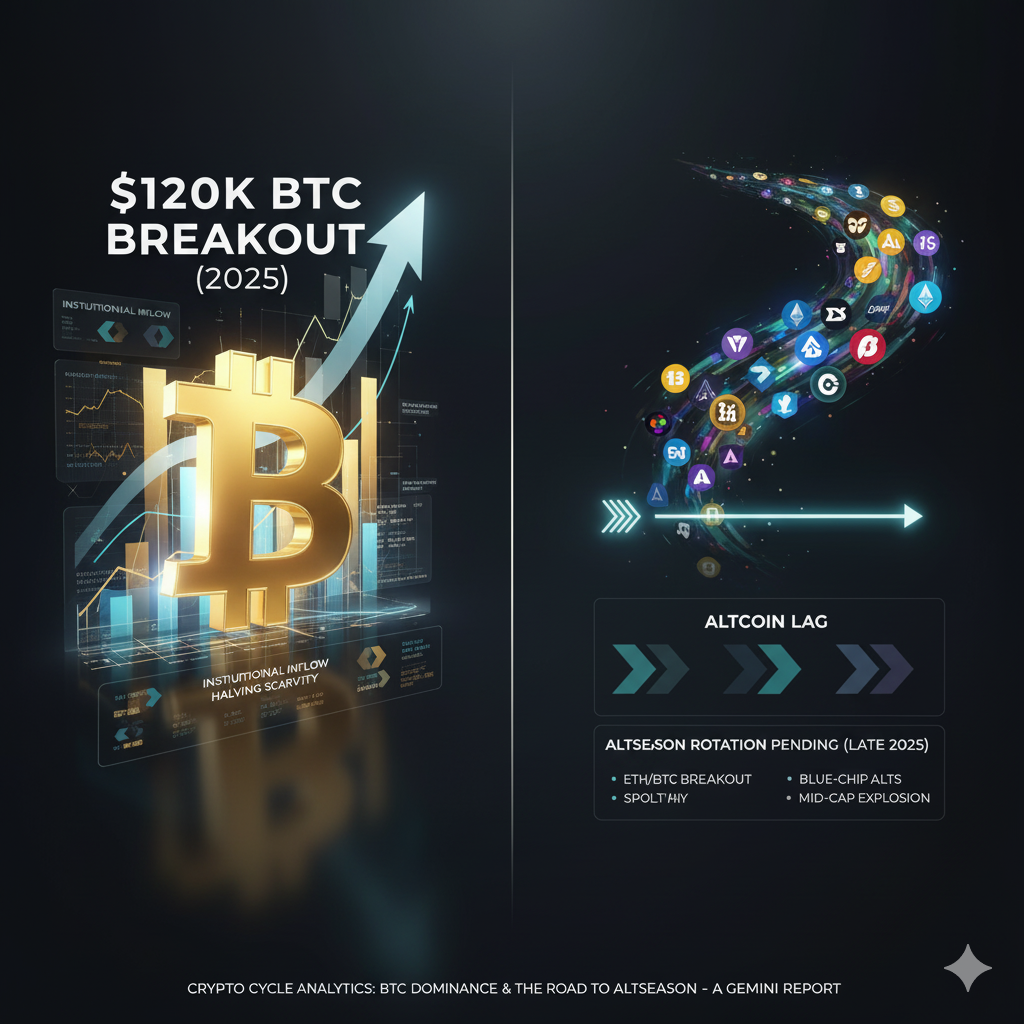
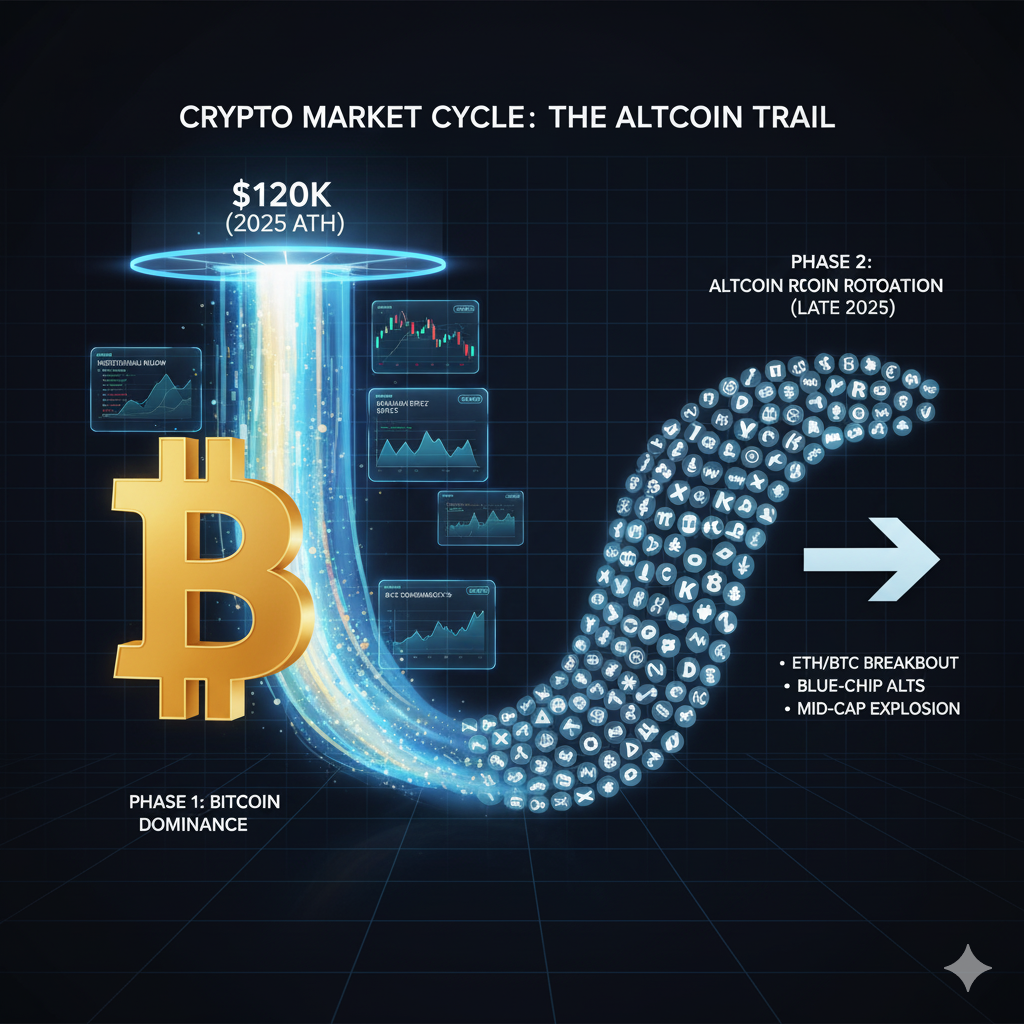
Here we are in 2025, and Bitcoin is rewriting history — blasting past $120,000, shattering psychological barriers, and once again pulling global attention back to crypto.
If this sounds familiar, it should. Back in late 2021, Bitcoin’s surge to $69,000 sparked a euphoric altcoin boom that sent Ethereum, Solana, and countless others to record highs. But the current cycle looks different.
This time, Bitcoin’s dominance has strengthened, while altcoins have struggled to find momentum. What changed between the 2021 bull run and 2025’s institutional wave?
Let’s unpack the story.
1. From Retail Mania to Institutional Muscle
The 2021 rally was powered by retail FOMO — millions of small traders chasing meme coins, NFTs, and DeFi yield farms. Bitcoin was the gateway, but altcoins captured the spotlight.
- Ethereum (ETH) soared past $4,800 on DeFi and NFT mania.
- Solana (SOL) exploded from under $2 to nearly $250, thanks to its fast network and VC hype.
- Meme coins like Dogecoin and Shiba Inu dominated social media and short-term trading.
Fast forward to 2025, and the dynamic has flipped.
Now, the rally is institutional, not retail. Bitcoin’s ETF approval in the U.S. (late 2024) opened the floodgates for Wall Street capital. Pension funds, asset managers, and family offices are buying Bitcoin as a digital gold hedge — but not altcoins.
Result: Bitcoin dominance surged above 55%, while altcoin liquidity remains thin.
2. Ethereum Holds Ground — But Lags BTC
Ethereum has held up better than most, trading near $4,200 as of October 2025. The Dencun upgrade and Layer-2 scaling have lowered fees, and real-world assets (RWA) are driving institutional interest.
However, ETH has yet to outperform Bitcoin — the ETH/BTC ratio is still near its lowest point since 2020. Until Bitcoin cools and capital rotates, Ethereum’s relative underperformance may persist.
Still, ETH remains the anchor of the altcoin ecosystem — and once BTC stabilizes, it’s typically the first alt to move.
3. Solana, Avalanche, and the Layer-1 Hangover
In 2021, Layer-1 wars defined the alt season. Solana, Avalanche, and Terra all challenged Ethereum’s dominance with speed and scalability.
But 2025’s landscape is more sober:
- Solana (SOL) remains resilient around $160–$180, buoyed by strong developer activity and on-chain volume.
- Avalanche (AVAX) has struggled to regain traction, trading near $35, as new L2 networks on Ethereum capture more attention.
- Terra (LUNA) never recovered from its 2022 collapse, leaving investors more cautious about flashy narratives.
The takeaway? Investors are favoring utility and sustainability over hype this time.
4. XRP, Cardano, and the “Old Guard”
While XRP finally gained clarity from the SEC lawsuit, it hasn’t translated into major price action. Its utility narrative remains strong, but the lack of speculative frenzy keeps it subdued.
Cardano (ADA) continues to develop quietly, focusing on governance and scaling, but retail excitement is muted compared to its 2021 highs near $3.
The “old guard” alts now function more like legacy networks — respected, but no longer the center of attention.
5. Meme Coins: From Hype to Survivors
The meme coin phenomenon isn’t dead — it’s just more selective.
Dogecoin (DOGE) and Shiba Inu (SHIB) still have loyal communities, but new entrants like Pepe and Turbo showed that speculative microcycles still exist.
However, without fresh retail money, these pumps are short-lived. The 2021-style retail mania hasn’t returned — at least not yet.
6. Macro and Market Psychology: Safety First
In 2025, macro conditions favor hard assets and defensive positioning. Inflation is easing but persistent, and the Federal Reserve’s slow rate cuts have made Bitcoin the go-to hedge.
Altcoins, by contrast, are viewed as risk assets — closer to early-stage tech stocks.
Institutional capital prefers the clarity and liquidity of Bitcoin over the volatility and regulatory uncertainty of smaller tokens.
This explains why Bitcoin thrives while alts stagnate: different investor classes, different priorities.
7. When Could Altseason Finally Arrive?
Historically, altcoins begin to outperform after Bitcoin consolidates near a new high.
In 2021, altseason followed about two months after BTC peaked.
In 2025, the same pattern could emerge — but on a slower, more mature timeline.
Here’s what to watch:
- BTC dominance dropping below 50%
- ETH/BTC breaking above 0.07
- Renewed retail inflows into exchanges
- Strong upticks in DeFi total value locked (TVL) across Ethereum and Solana
When those signals align, the next altseason could begin — possibly in early to mid-2026.
Bottom Line
The 2025 bull run is not a replay of 2021 — it’s a new phase of crypto maturity.
Bitcoin’s rise past $120,000 has been powered by institutional adoption, ETF flows, and macro stability, not retail hype.
Altcoins are lagging, but that doesn’t mean they’re dead. In fact, history suggests they’re simply waiting for Bitcoin to pause — and when it does, the next rotation could be explosive.
For savvy investors, that means staying patient, informed, and ready.
Because when altseason finally flips, it rarely gives a warning.